Infrastructure & Energy · Living in Ecuador
Ecuador’s solar industry is growing from the bottom up
Ecuador’s distributed solar market is expanding rapidly while El Aromo, its largest awarded solar project, remains in pre-construction.
Published Updated

Ecuador’s solar industry has begun growing rapidly—but largely without the big power plants once expected to drive the sector.
Businesses, farms and households are installing distributed generation, while the country’s largest solar project remains unbuilt.
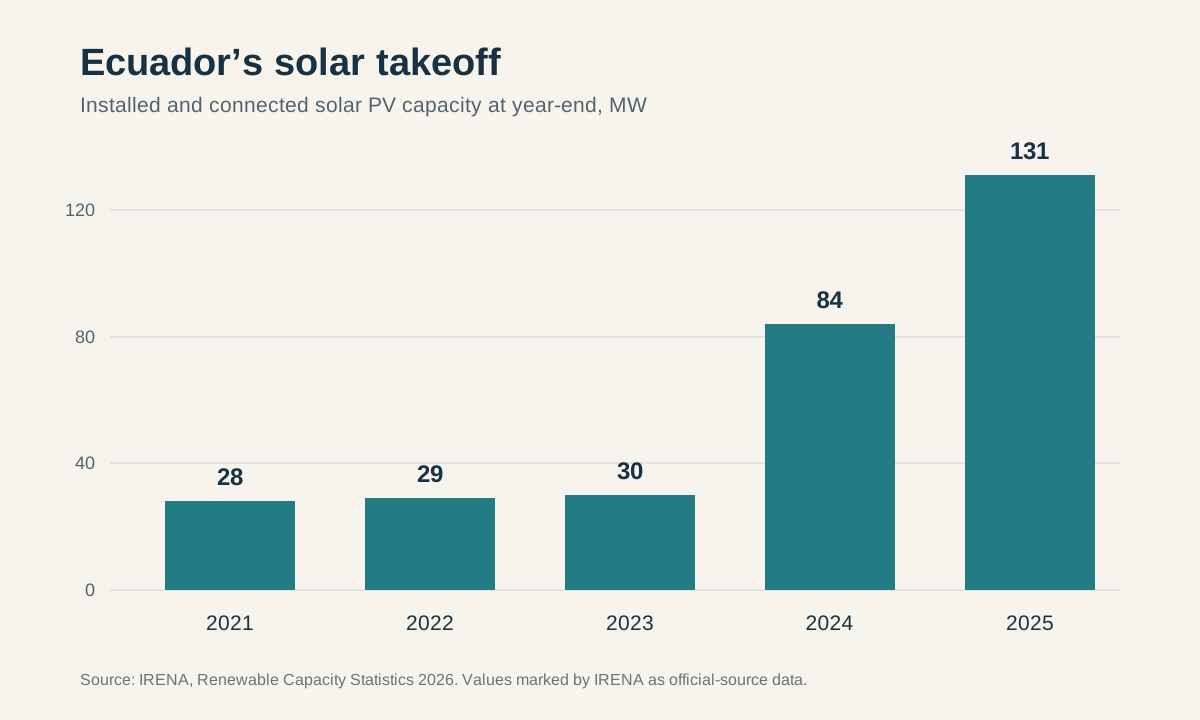
Ecuador had 131 megawatts of installed and connected solar photovoltaic capacity at the end of 2025, according to the International Renewable Energy Agency, or IRENA. The figure, marked by IRENA as coming from an official source, was up from 84 MW in 2024 and only 30 MW in 2023.
More recent data from Ecuador’s electricity regulator show that the expansion continued during 2026.
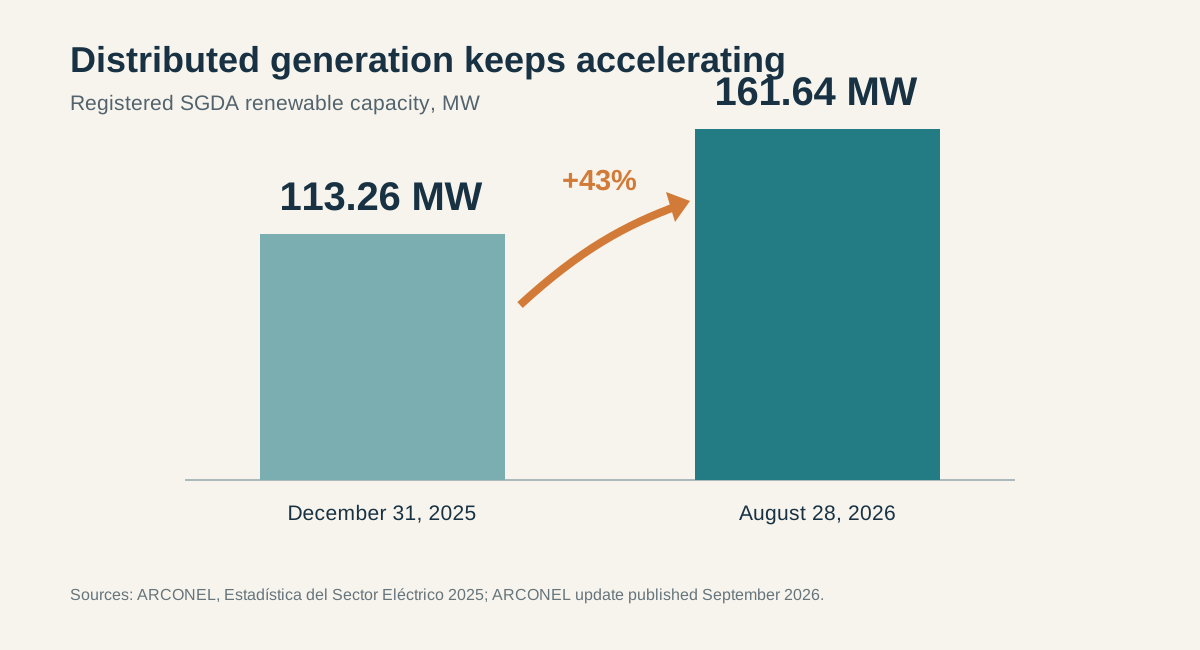
ARCONEL recorded 113.26 MW of distributed renewable self-generation at the end of 2025. In an update published in September, the regulator said that capacity had reached 161.64 MW across 2,806 operating systems as of August 28, 2026.
That is the most recent official snapshot identified for this article. It shows distributed capacity growing by almost 43% in eight months.
The number of systems increased from 2,359 at the end of 2025 to 2,806 in August 2026, or approximately 19%. Because capacity grew much faster than the number of installations, larger commercial and industrial systems appear to be taking an increasingly important role.
The two headline figures are not contradictory. IRENA’s 131 MW is a year-end 2025 total specifically for solar PV. ARCONEL’s 161.64 MW is an August 2026 total covering qualifying distributed renewable systems. They refer to different dates and categories and should not be added together.
ARCONEL has not published a current technology-by-technology breakdown of the distributed total, although it describes the program as being driven principally by photovoltaic solar.
Diesel backup generators are not included in the 161.64 MW SGDA total. Under Ecuador’s regulations, a Sistema de Generación Distribuida para Autoabastecimiento, or SGDA, must use a non-conventional renewable source. Emergency diesel generators are regulated separately.
Together, the figures show a market advancing from the bottom up: private distributed generation is growing faster than Ecuador’s large centrally planned solar projects.
For installation prices, batteries, grid-connection procedures and practical advice for homes and businesses, see our guide to installing solar power in Ecuador.
Solar growth accelerated after 2023
Installed solar PV capacity increased by approximately 337% between the end of 2023 and the end of 2025.
This is rapid growth from a very small base. Solar still represents only a minor part of Ecuador’s electricity system, which remains dominated by hydroelectric generation.
The drought and power cuts of 2024 strengthened the case for private generation. Electricity shortages exposed the cost of relying entirely on the public network, particularly for manufacturers, cold-storage facilities, farms, pumping systems, offices and other businesses with daytime demand.
Solar can reduce electricity purchases during the day. When combined with suitable batteries and electrical equipment, it can also provide power during an outage. But those are separate functions.
How many systems provide backup power?
The national statistics do not say.
ARCONEL reports the number and generating capacity of distributed systems, but not how many include batteries or can operate when the grid fails. A standard grid-connected system normally shuts down during an outage; backup requires additional equipment and storage.
The SGDA statistics therefore measure renewable generating capacity—not blackout protection. Our practical solar guide explains which systems can operate during an outage.
Imports support the picture of a growing market
Commercial aggregations of customs records place Ecuador’s 2025 imports of photovoltaic modules at approximately US$25 million to US$27 million.
The records cover photovoltaic cells assembled into modules or panels, not the other equipment and materials needed for an installation, including inverters, batteries, controllers, mounting systems, cables and protection equipment.
They include large consignments of 720, 1,782, 2,160 and 2,650 modules, principally from China. They also include small and portable panels, so import records cannot be converted directly into installed capacity.
The value of 2025 imports is consistent with the increase in installed capacity, although a comparable official annual import series has not yet been obtained.
Coast or Sierra: where does solar work better?
There is no single regional winner.
Parts of the Sierra offer strong irradiation, cooler operating temperatures and the benefit of elevation. The Coast offers flatter land, large industrial loads and, in some places, easier access to major transmission infrastructure.
Solar panels convert light, not heat. Depending on the module, maximum output commonly falls by approximately 0.3% to 0.5% for every degree Celsius of increase in cell temperature.
Sunny high-altitude locations can combine strong radiation with cooler panels. But cloud cover, mountain shadows, steep land and limited transmission access can reduce or complicate production.
The Coast has a useful solar resource, and its production can coincide with air-conditioning, refrigeration, commerce and industry. Flatter land can simplify large projects, although heat, salt, humidity and soiling affect performance and maintenance.
A sunny and cool highland site may provide better panel-level performance. A coastal project may still produce less expensive delivered electricity if it offers accessible land, nearby demand and an economical grid connection.
The place with the strongest sunlight is not necessarily the best place to build a power plant.
Property-level design considerations for the Coast, Sierra, Amazon and Galápagos are covered in our practical installation guide.
What can—and cannot—be said about generation costs
Electricity costs can be misleading unless they are calculated on the same basis.
The operating cost of an existing hydroelectric plant is not comparable to the lifetime cost of building a new solar project. A long-term power-purchase agreement is different from a retail tariff. Thermal contracts may contain separate payments for fuel, capacity or availability.
For new projects, ARCONEL published these preferential levelized costs of energy, or LCOE, in 2025:
| New generation technology | ARCONEL reference cost |
|---|---|
| Hydroelectric, Amazon basin | 6.35 US cents/kWh |
| Hydroelectric, Pacific basin | 6.76 US cents/kWh |
| Solar photovoltaic | 8.04 US cents/kWh |
The solar reference includes limited battery storage equal to 10% of project capacity, with four hours of charge and discharge capability. It also allows for a grid connection of up to 25 kilometres.
The winning price for the proposed El Aromo solar plant was lower: 6.935 cents/kWh. That was a project-specific competitive offer made in 2020, not a general price for solar generation.
Recent thermal arrangements provide a different type of comparison:
| Thermal reference | Approximate cost |
|---|---|
| Recent floating thermal generation | 8.97 cents/kWh |
| Emergency generation using fuel oil No. 6 | 22.14 cents/kWh |
| Emergency generation using diesel 1 or 2 | 39.74 cents/kWh |
| Emergency generation using premium diesel | 48.32 cents/kWh |
These are not directly comparable LCOE figures. The floating-generation number is a contract price. The emergency values compensate private owners for operating existing generators and include operation, maintenance, fuel and transportation.
They nevertheless show how costly electricity becomes when Ecuador must resort to emergency fuel-oil or diesel generation.
New solar and hydro appear reasonably competitive in Ecuador’s regulatory references. Thermal power becomes substantially more expensive when procured as emergency or small-scale generation.
The technologies do not provide identical services. Solar supplies variable daytime energy. Hydroelectric plants may offer storage and rapid response but are exposed to drought. Thermal plants generally produce more expensive electricity and emissions, but they can operate at night and during prolonged periods of low water.
Can Ecuador’s grid absorb more solar?
At the national level, Ecuador does not yet face the pronounced “duck curve” seen in places with much higher solar penetration.
A duck curve appears when solar production pushes demand for other power plants down during the middle of the day, followed by a rapid increase as the sun sets and evening consumption rises.
Ecuador already has the evening peak from which such a curve could develop. Maximum demand has historically occurred between approximately 19:00 and 22:00, after solar output has largely disappeared.
But current solar capacity is small compared with national demand. Even if all 161.64 MW of distributed renewable capacity recorded in August were solar and operating at rated output simultaneously—which it was not—it would equal only about 3% of peak national demand.
Daytime demand is also substantial. During hot weather in May 2026, consumption reached 5,387 MW at 15:00, driven especially by Guayas and Los Ríos. Air-conditioning, refrigeration, commerce and industry provide demand while panels are producing.
Ecuador has the evening peak that could eventually form the head of a duck curve, but it does not yet have enough solar to create a deep midday trough.
The more immediate issue is local grid capacity. A distribution feeder with several large solar systems may experience voltage or reverse-flow problems even when the national system can absorb the electricity.
Behind-the-meter generation also complicates forecasting because it appears to the system operator as reduced demand rather than centrally measured production.
If Ecuador adds several hundred megawatts of solar, storage, flexible demand and better forecasting will become more important. For now, local network limits are a greater concern than national oversupply.
Ecuador remains behind its neighbours
At the end of 2025, IRENA reported 12,032 MW of solar PV in Chile, 1,726 MW in Colombia and 1,016 MW in Peru, compared with Ecuador’s 131 MW.
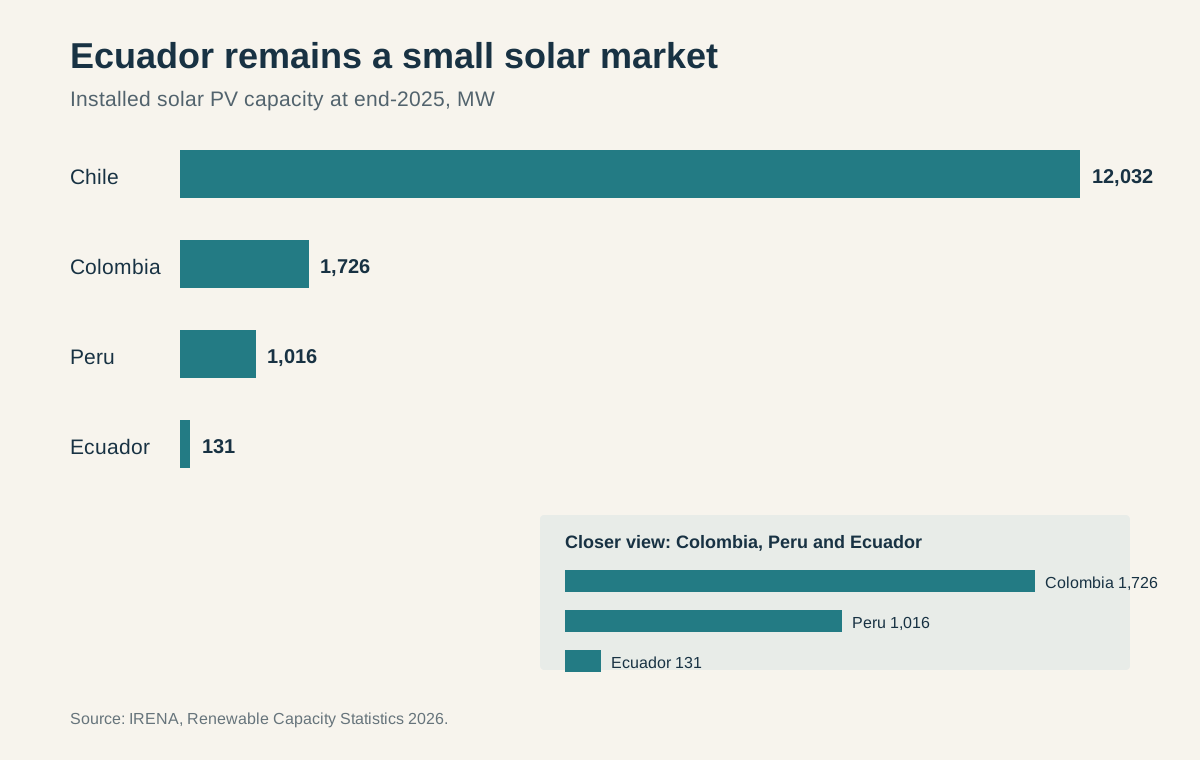
Chile had approximately 92 times Ecuador’s capacity. Colombia had 13 times as much, and Peru nearly eight times as much.
The comparison requires context. Chile has the exceptional Atacama solar resource, and each country has different investment rules, auctions and transmission constraints.
The figures nevertheless show how little of Ecuador’s solar potential has been developed.
What the industry looks like now
The August 2026 ARCONEL update is the clearest sign of the market’s current direction.
Distributed renewable capacity rose from 113.26 MW at the end of 2025 to 161.64 MW by August 28, 2026. In eight months, Ecuador added more than 48 MW in this category.
Commercial and industrial projects appear to be taking a larger role. Module imports support the picture of a growing market. Daytime demand is large enough to absorb considerably more solar, and current penetration remains too low to create a national oversupply problem.
The immediate challenges are practical: determining where networks can accept more generation; making connection studies predictable; measuring how many systems include useful battery backup; improving visibility of generation behind customer meters; expanding transmission where necessary; and moving large awarded projects into construction.
For now, Ecuador’s solar expansion is happening mainly on private property. Whether that bottom-up growth becomes a durable part of the electricity system will depend on regulation and grid investment keeping pace.
Sidebar: El Aromo—awarded in 2020, still not under construction
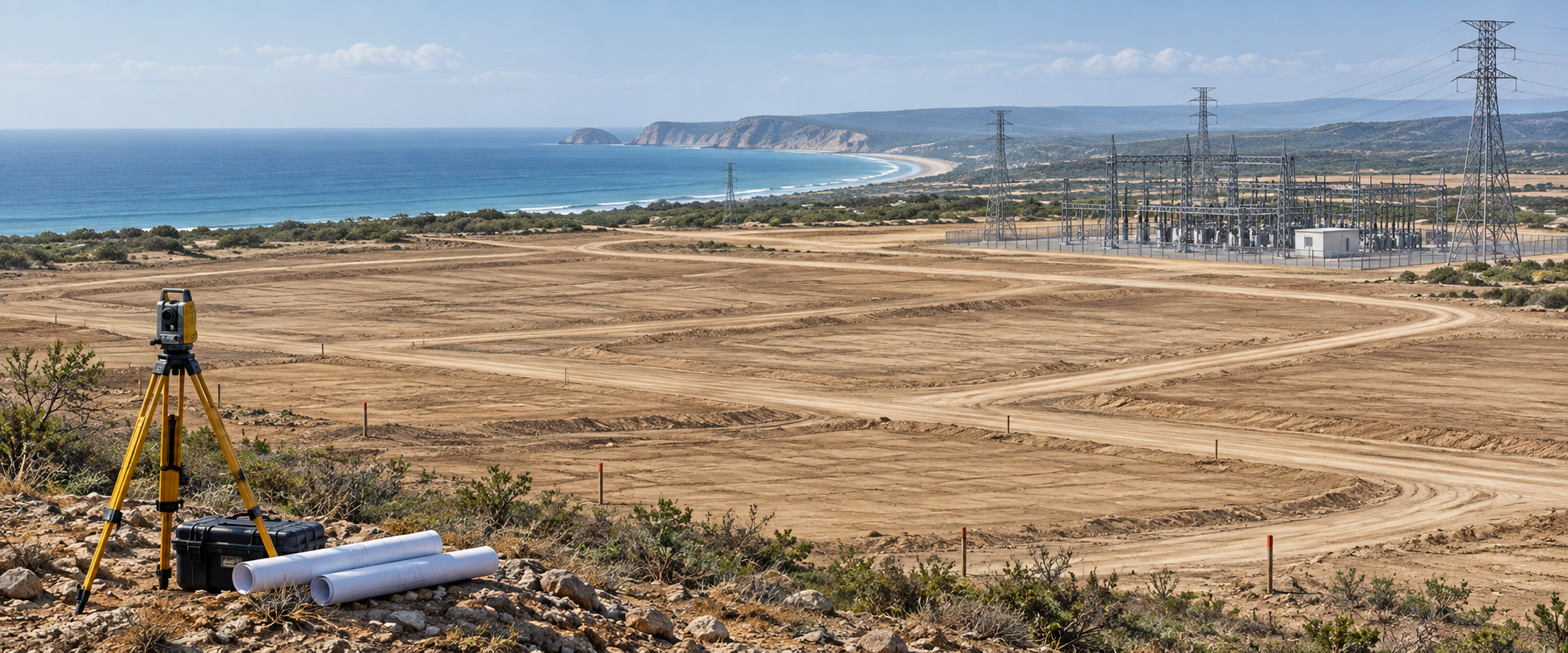
Ecuador awarded the 200 MW El Aromo solar project in December 2020. Almost six years later, full construction has still not been publicly confirmed.
The proposed plant would be larger than Ecuador’s entire 131 MW solar photovoltaic fleet at the end of 2025. It has a site, a nearby high-voltage connection, an environmental licence and a signed concession.
What it does not yet appear to have is a verified construction start.
El Aromo is planned for approximately 300 hectares near land prepared for the unsuccessful Refinería del Pacífico project, about 20 kilometres from Manta. It would connect to the national transmission system through the 230-kilovolt San Juan de Manta substation.
Government documents have projected annual production of approximately 280 gigawatt-hours. Some reports around the 2020 competition cited 340 GWh, a discrepancy that should be resolved against the final technical design.
Solarpackteam won the project with a reported electricity price of 6.935 US cents per kilowatt-hour. The concession-stage investment was reported at approximately US$144 million to US$145 million.
When the contract was signed in March 2023, construction was expected to take about 18 months and the plant was expected to be completed in 2025. That schedule has passed.
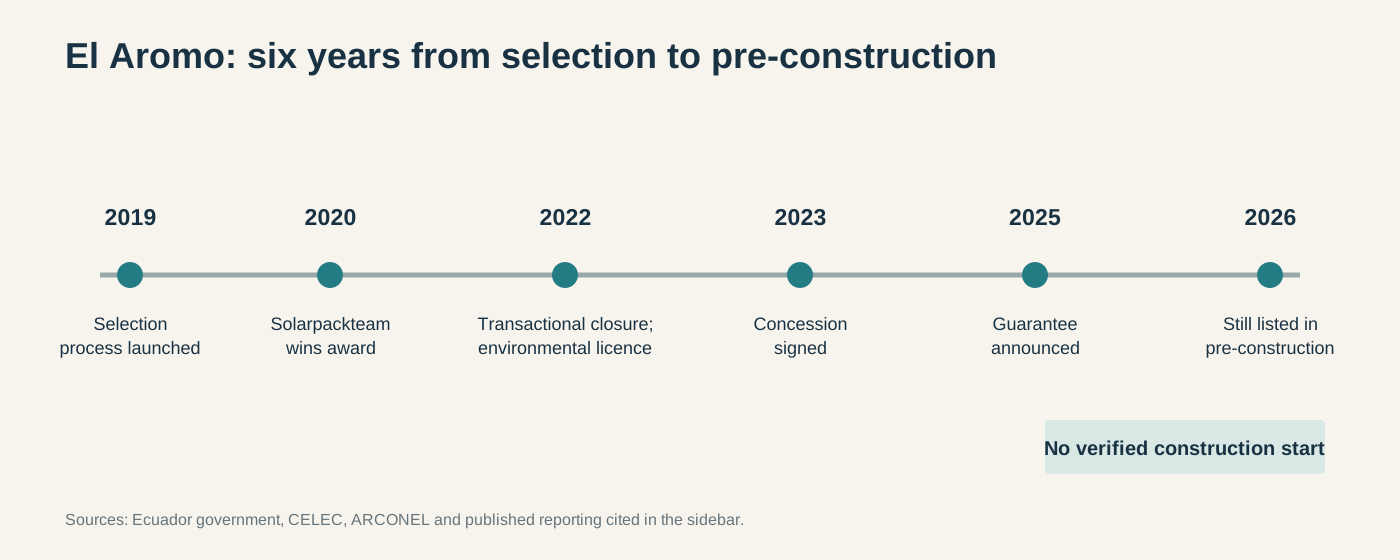
Public records show that unresolved contractual conditions delayed construction. Published reporting identifies payment security as a principal obstacle.
A private developer may be unable to obtain long-term financing if lenders are not satisfied that the purchaser of the electricity will meet its payment obligations.
In June 2025, the government said El Aromo was among 12 renewable projects expected to benefit from a US$77 million Inter-American Development Bank guarantee arrangement. But inclusion in a guarantee program does not establish that the guarantee is operational, financing has closed or construction has been authorized.
As of the latest available published information, El Aromo should be described as a contracted and environmentally licensed project in pre-construction.
Publicly available records do not confirm completion or waiver of all conditions precedent, implementation of the payment guarantee, financial close, a formal notice to proceed, physical mobilization, a revised construction schedule or a new commercial-operation date.
Some newspaper archive pages currently show September 2026 dates for stories announcing transactional closure. Their text describes the closure reported in September 2022, before the March 2023 concession signing. Those dates should not be interpreted as evidence of a new transactional closure in 2026.
The accurate status is:
El Aromo completed transactional closure in 2022 and signed its concession in 2023, but unresolved contractual and financing requirements continued to prevent a confirmed construction start through the information available in 2026.
By August 2026, Ecuador had 161.64 MW of distributed renewable self-generation—approaching the proposed capacity of El Aromo.
Thousands of consumers have been able to install individual systems more quickly than the country has been able to move one major competitively awarded plant into construction.
El Aromo’s problem is not primarily a lack of sunlight or land. It is the gap between awarding a project and creating the payment security, financing and administrative continuity needed to build it.
Until published information confirms financial close, notice to proceed and physical mobilization, El Aromo remains a major project on paper rather than an operating part of Ecuador’s electricity system.
Source notes
- IRENA, Renewable Capacity Statistics 2026
- ARCONEL’s August 28, 2026 SGDA figures
- ARCONEL, Estadística del Sector Eléctrico Ecuatoriano 2025
- ARCONEL Regulation 005/24
- ARCONEL preferential generation costs
- ARCONEL emergency-generator compensation
- CENACE annual report for 2025
- NREL on photovoltaic temperature effects
- NBD module-import summary
- CELEC: El Aromo interconnection
- Government announcement of the March 2023 concession
- Government evaluation acknowledging delayed construction
- El Aromo and the proposed BID guarantee
- ARCONEL 2025 accountability report
This article is based on available published information. Figures will be updated if more recent or more detailed public data become available.