Infrastructure & Energy · Living in Ecuador
Solar Takes Off in Ecuador: Blackouts, New Rules and Private Investment Reshape the Power Market
Ecuador’s 2024 power crisis and new self-generation rules are accelerating private solar investment, from distributed systems to Río de Oro and Faro de San Marco.
Published Updated
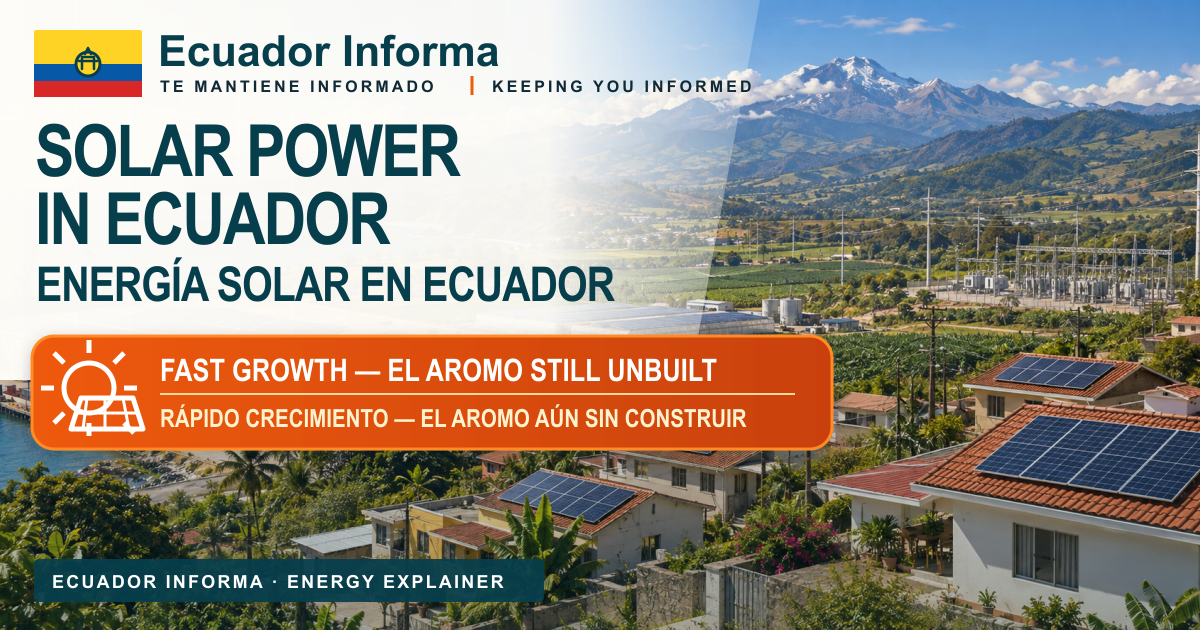
For years, solar power was a marginal part of Ecuador's electricity system. That is changing quickly.
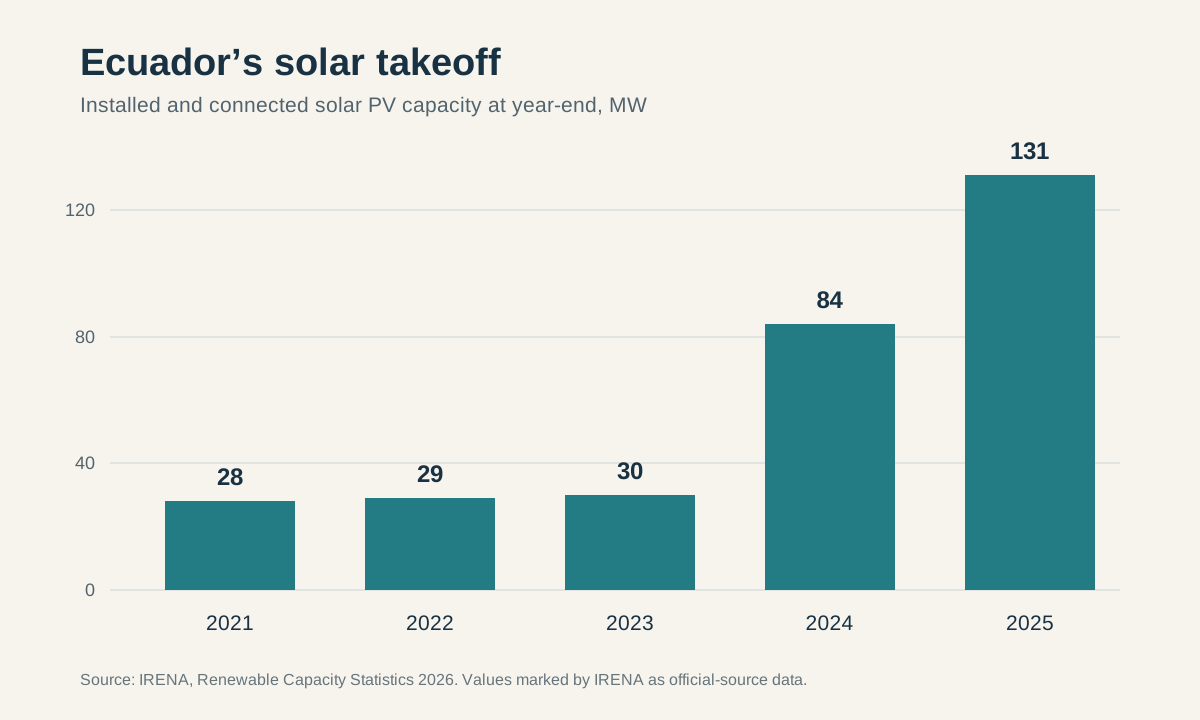
At the end of 2023, Ecuador had only about 30 megawatts (MW) of installed solar photovoltaic capacity. By the end of 2024, that had risen to 84 MW, and by the end of 2025 to 131 MW, according to the International Renewable Energy Agency.
The national total remains small compared with countries such as Chile, Colombia and Peru, but the pace of growth has changed sharply.
More importantly, Ecuador is no longer seeing only small rooftop installations. Large industrial systems, remote self-supply projects and privately financed solar farms are now appearing alongside thousands of smaller distributed-generation systems.
The change has been driven by two closely connected events: the electricity crisis of 2024 and a government requirement that some of the country's largest electricity consumers develop generation capable of covering their own demand.
From blackouts to self-generation
Ecuador depends heavily on hydroelectricity. That provides relatively inexpensive renewable power when rainfall and reservoir levels are adequate, but the 2024 drought exposed the risks of depending so heavily on water.
Businesses faced prolonged power cuts, factories changed production schedules and many companies bought emergency generators.
Then, in June 2025, Executive Decree 32 gave high-voltage electricity customers 18 months to implement their own generation capacity.
The deadline falls in December 2026.
The measure applies to a relatively small number of very large electricity consumers, including industrial operations in sectors such as cement, steel, mining, plastics and shrimp processing.
By September 2026, reporting indicated that 135 high-consumption companies still did not have enough generation to cover their demand.
That requirement has helped create a market for much larger private-generation projects.
Río de Oro: solar without putting panels on the factory
One of the clearest examples is Río de Oro Energy in Santa Elena.
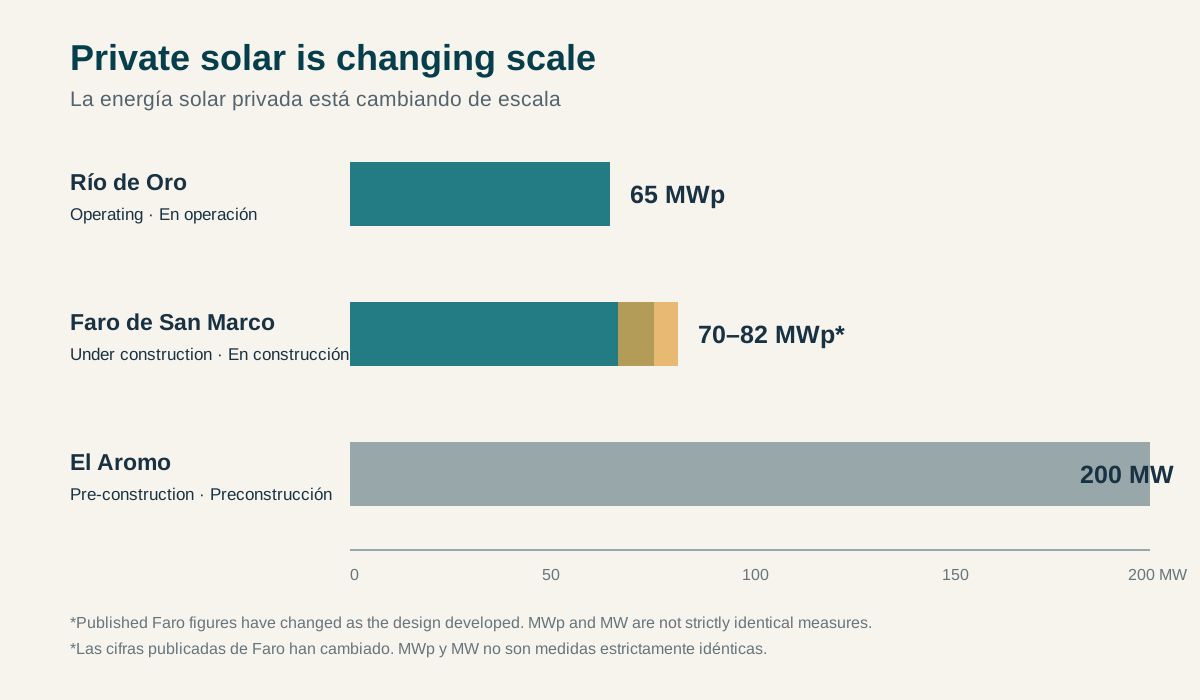
The privately financed project began supplying electricity in September 2026 and has a stated photovoltaic capacity of 65 MWp, with expected generation of approximately 90 million kWh per year.
Investment exceeds USD 50 million.
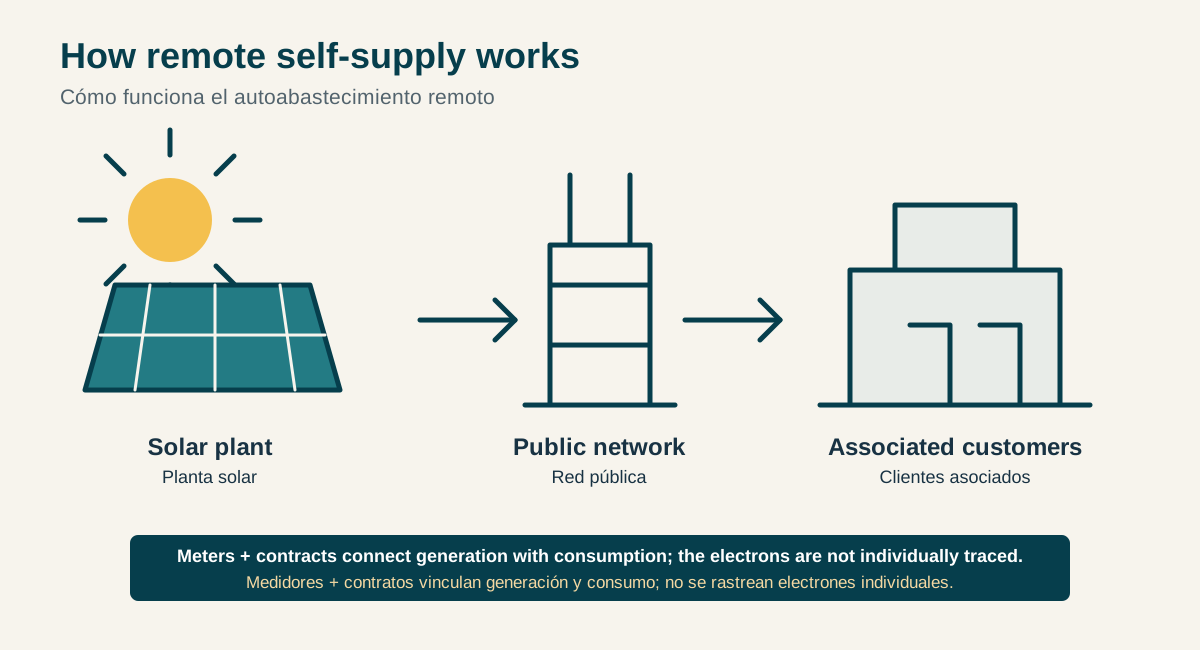
The project uses a remote self-supply model.
Commercial and industrial customers contract electricity from Río de Oro even though the solar plant may be many kilometres from their facilities. Electricity from the plant enters the existing CNEL network, while the customer's contracted generation is accounted for against its electricity consumption.
That means a large factory does not necessarily need enough roof or land to build its own solar plant.
GPS Group says its customers sign 10-year contracts and that all of Río de Oro's planned output has already been contracted. Those contract and production figures come from the developer.
The company also says it has six additional large photovoltaic projects under development in Santa Elena, Guayas and Manabí, together with another phase of Río de Oro, with a goal of 330 MWp operating by December 2027. That is a development target, not capacity already operating or under construction.
That would be more than two and a half times Ecuador's entire solar capacity recorded at the end of 2025.
Another 75 MW nearby
Río de Oro is not alone.
Also in Santa Elena, Faro de San Marco is under construction. Published descriptions have put its planned capacity at approximately 70–75 MWp; a later statement from a project representative referred to 82 MWp as construction approached its final stage.
Earlier published project information described about 122 hectares and initial investment of approximately USD 50–60 million.
By the end of August 2026, construction was reported at about 65% completion. Until a final technical record is published, the capacity and investment figures should be treated as evolving project estimates.
Using the earlier 75 MWp figure for Faro de San Marco, the two projects represent approximately 140 MWp. The combined figure would be higher if the later 82 MWp design is confirmed.
That is slightly more photovoltaic capacity than IRENA recorded for all of Ecuador at the end of 2025.
The comparison shows how quickly the scale of private solar investment is changing.
Thousands of smaller systems are growing too
Large solar farms are only part of the picture.
ARCONEL reported that by August 28, 2026, Ecuador had 2,806 distributed renewable self-generation systems with combined capacity of 161.64 MW.
These systems range from relatively small rooftop installations to substantial commercial and industrial projects. ARCONEL describes the expansion as being driven mainly by solar photovoltaic generation, but the published 161.64 MW total is not a solar-only figure.
The statistics also do not say how many systems include batteries or can operate when the public grid fails. A standard grid-connected solar system normally shuts down during an outage unless it has suitable backup equipment and storage.
For homeowners and smaller businesses interested in the practical side of solar — including system prices, batteries, grid connection, energy credits and choosing equipment for the Coast or Sierra — Ecuador Informa has a separate guide:
Solar power in Ecuador as of September 2026 explains installation prices, batteries, grid connections, regional conditions and government support.
Where is solar best in Ecuador?
Ecuador receives useful solar radiation throughout the year, but the best place for solar is not necessarily the hottest place.
Parts of the Sierra, including Pichincha, Cotopaxi and Loja, have very strong solar resources. Cooler temperatures can also help photovoltaic modules operate more efficiently because panels lose some output as they become hotter.
That gives some high-altitude areas an excellent combination of strong sunlight and relatively cool operating conditions.
So why are large projects appearing in places such as Santa Elena?
Because the efficiency of an individual panel is only one part of the economics of a solar farm.
Large projects also need:
- suitable and affordable land;
- relatively easy construction conditions;
- road access;
- available grid capacity;
- nearby transmission or distribution infrastructure;
- and access to large electricity consumers.
Santa Elena performs well on many of those criteria and has become one of the emerging centres of Ecuador's large-scale private solar industry.
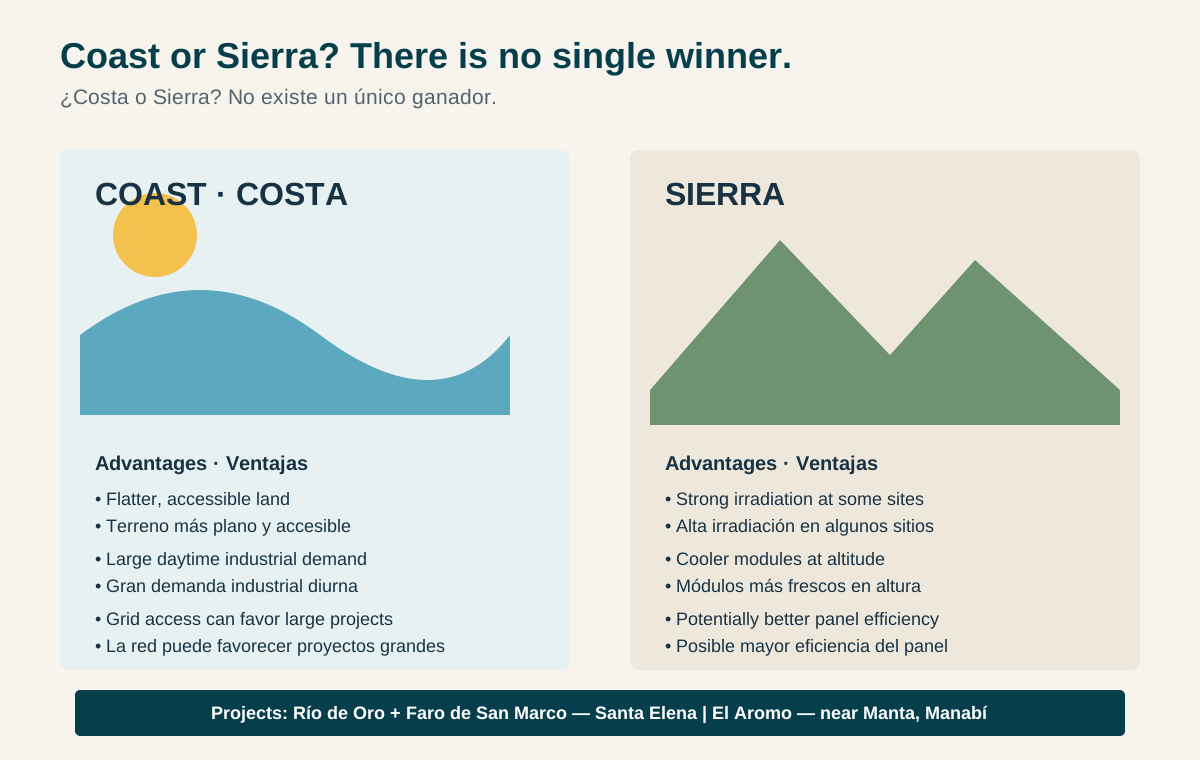
The distinction is important:
The place where a solar panel performs best is not necessarily the place where a large solar farm is easiest or cheapest to build.
El Aromo near Manta: the slower model
The long-planned El Aromo photovoltaic project, about 20 kilometres from Manta, remains important even though it is no longer the centre of Ecuador's solar story.
El Aromo is designed for approximately 200 MW of capacity on roughly 300 hectares of land originally prepared for the unsuccessful Refinería del Pacífico project.
Earlier technical plans projected about 280 GWh of annual electricity production. Its location was attractive partly because the prepared land lies close to Manta and the plant could connect to the national transmission system through the San Juan de Manta 230-kV substation.
But El Aromo has moved much more slowly than the emerging private projects.
The selection process began in 2019, and Solarpackteam was awarded the project in 2020.
Years of contractual and administrative work followed. Transactional closure was reported in September 2022, and the concession contract was signed in March 2023. Some newspaper archive pages now display 2026 dates on older closure reports, but their text describes the 2022 milestone; they are not evidence of a new transactional closure in 2026.
The project has an environmental licence and signed concession, but publicly available information through October 2026 does not verify financial close, a formal notice to proceed or physical construction mobilization. The most defensible description is that El Aromo remains in pre-construction.
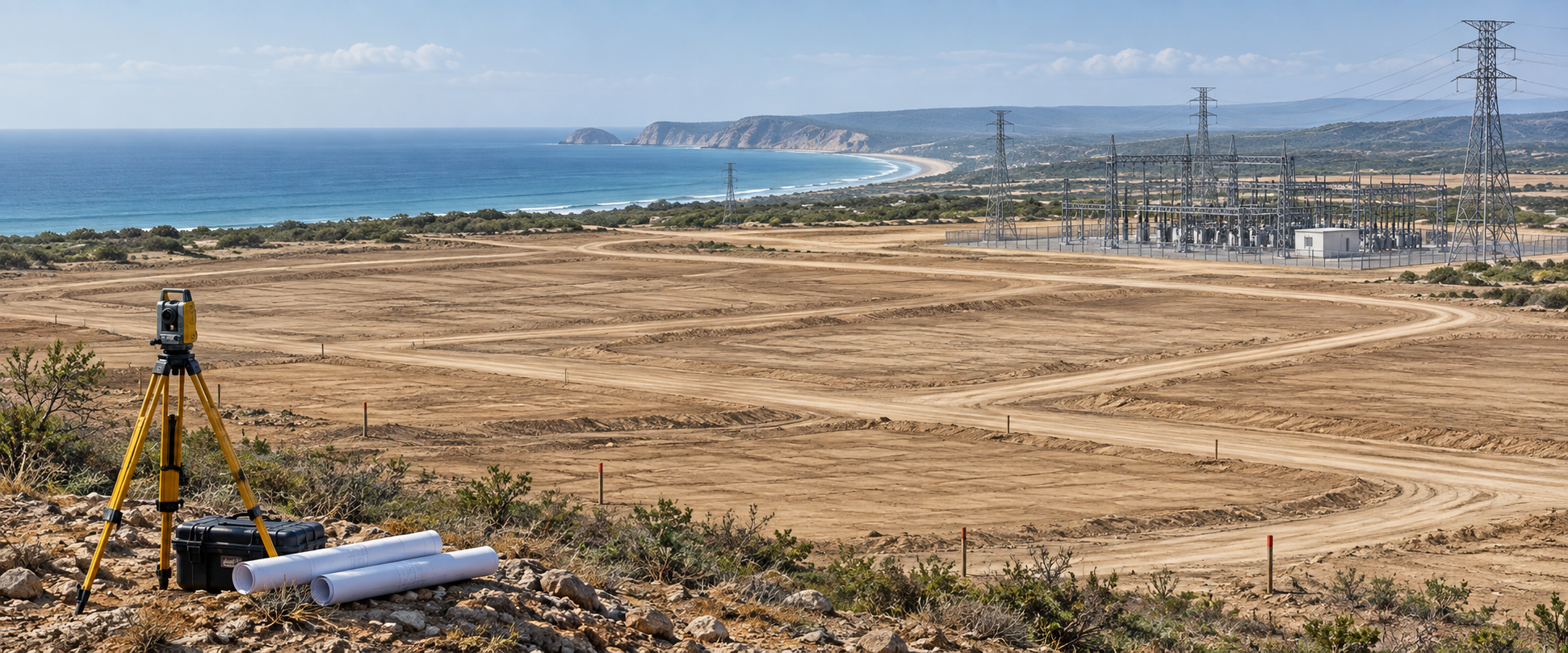
During that same period, private projects such as Río de Oro moved into actual electricity production.
That contrast illustrates an important change in Ecuador's electricity sector: solar development is increasingly being driven not only by national generation planning, but also by private companies responding directly to their own electricity needs.
Solar cannot solve the electricity problem alone
Solar generation has an obvious limitation: it is intermittent.
A solar plant can produce strongly during daylight hours but generates nothing after sunset, while clouds can reduce output during the day.
Industrial customers often need electricity around the clock.
Ecuador therefore still requires firm generation, energy storage, stronger interconnections or other generating sources capable of supplying electricity when solar is unavailable.
But solar can play an important supporting role in Ecuador's hydroelectric system.
Electricity produced during sunny daytime hours can reduce the amount of water that must be released through hydroelectric turbines and reduce fuel consumption at thermal plants.
That allows hydro reservoirs and other firm generation to be used when they are more valuable — particularly at night or during periods of low rainfall.
Still small, but growing rapidly
Ecuador remains well behind several neighbouring countries in total solar capacity.
At the end of 2025, IRENA recorded approximately:
- 12,000 MW in Chile;
- 1,726 MW in Colombia;
- 1,016 MW in Peru;
- 131 MW in Ecuador.
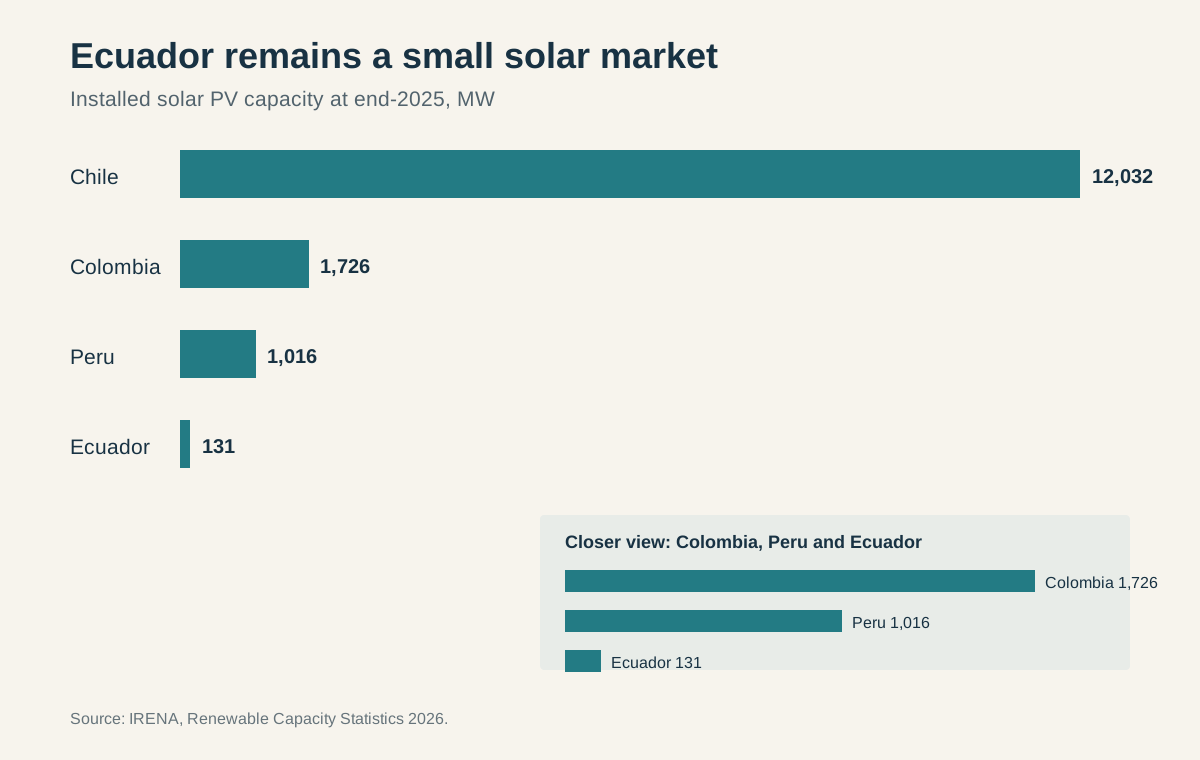
But Ecuador's recent progression tells another story:
30 MW in 2023
84 MW in 2024
131 MW in 2025
By August 2026, ARCONEL was already reporting more than 161 MW of distributed renewable self-generation capacity, while major new private plants were moving into construction and operation.
A different electricity market is emerging
The solar story in Ecuador is therefore about more than falling panel prices.
The 2024 electricity crisis made energy security a business issue.
The government subsequently required some of the country's largest electricity consumers to develop their own generation.
New regulatory mechanisms have made distributed and remote self-generation possible.
Private investors are now responding with projects measured not in dozens of rooftop panels, but in tens of thousands of panels and tens of megawatts.
Río de Oro shows how an industrial company can effectively secure solar generation without building a power plant beside its factory.
Faro de San Marco demonstrates the increasing scale of private investment.
Thousands of smaller self-generation systems are expanding in parallel.
And El Aromo, if finally constructed, could add another 200 MW.
Ecuador is still far from becoming a solar-dominated electricity system.
But the period from 2024 through 2026 appears to mark the point when solar moved from a relatively small niche into a significant part of Ecuador's electricity investment strategy.
Sources and verification notes
- IRENA, Renewable Capacity Statistics 2026: Ecuador's solar PV capacity through the end of 2025.
- Executive Decree 32, published in the Registro Oficial on June 18, 2025: the 18-month self-generation requirement for high-voltage tariff customers.
- ARCONEL's September 2026 update: 161.64 MW across 2,806 distributed renewable self-generation systems as of August 28, 2026.
- Ministry of Environment and Energy, GPS Group and October 2026 Ecuador reporting: Río de Oro's operating status, stated 65 MWp scale, investment and remote self-supply model.
- Published industry and company reporting on Faro de San Marco. Reported capacity has evolved from 70–75 MWp to a later 82 MWp statement and requires confirmation against the final technical record.
- CELEC and Government of Ecuador records on El Aromo's proposed interconnection, concession and projected generation.
This article uses published information available through October 7, 2026. Developer projections are identified as such, and project capacities or schedules should be updated when authoritative new records become available.