Infraestructura y energía · Loja · Wind Energy · Renewable Energy · Electricity Grid · Private Investment
Wind Power in Ecuador: Villonaco III and What Comes Next
From Ecuador’s first island turbines and Villonaco I to the construction of Villonaco III: where the projects are, how they work, and what could come next.
Publicado
When the final 27 turbine blades reached Puerto Bolívar in September 2026, Villonaco III passed a highly visible construction milestone. Together with an earlier shipment of 30 blades, Ecuador now had all 57 blades required for the project’s 19 wind turbines. Customs clearance and an unusual overland journey still separated the components from their mountain foundations in Loja.
Villonaco III is important, but it is not Ecuador’s first wind farm. It follows pioneering island installations in Galápagos, the original Villonaco plant outside Loja, and the larger Minas de Huascachaca project. It also sits within a much bigger pipeline of proposed wind developments whose future depends on financing, environmental review and new transmission capacity.
Villonaco III at a glance
| Feature | Current project information |
|---|---|
| Location | Huayrapamba area, principally around Chuquiribamba and Chantaco in Loja Province |
| Developer | VillonacoEnergy S.A., associated with Grupo Cobra |
| Project model | Privately financed development under a 25-year state concession |
| Turbines | 19 turbines rated at approximately 5.9 MW each |
| Installed capacity | 112.1 MW |
| Estimated annual production | Approximately 360 GWh |
| Grid connection | 33/138 kV project substation and approximately 24.5–25 km of 138 kV transmission line to the Loja substation |
| Investment | More than US$200 million; recent local reporting places it near US$230 million |
| Commercial-operation target | 2027; the target is a schedule, not a guarantee |
Where Ecuador’s wind projects are
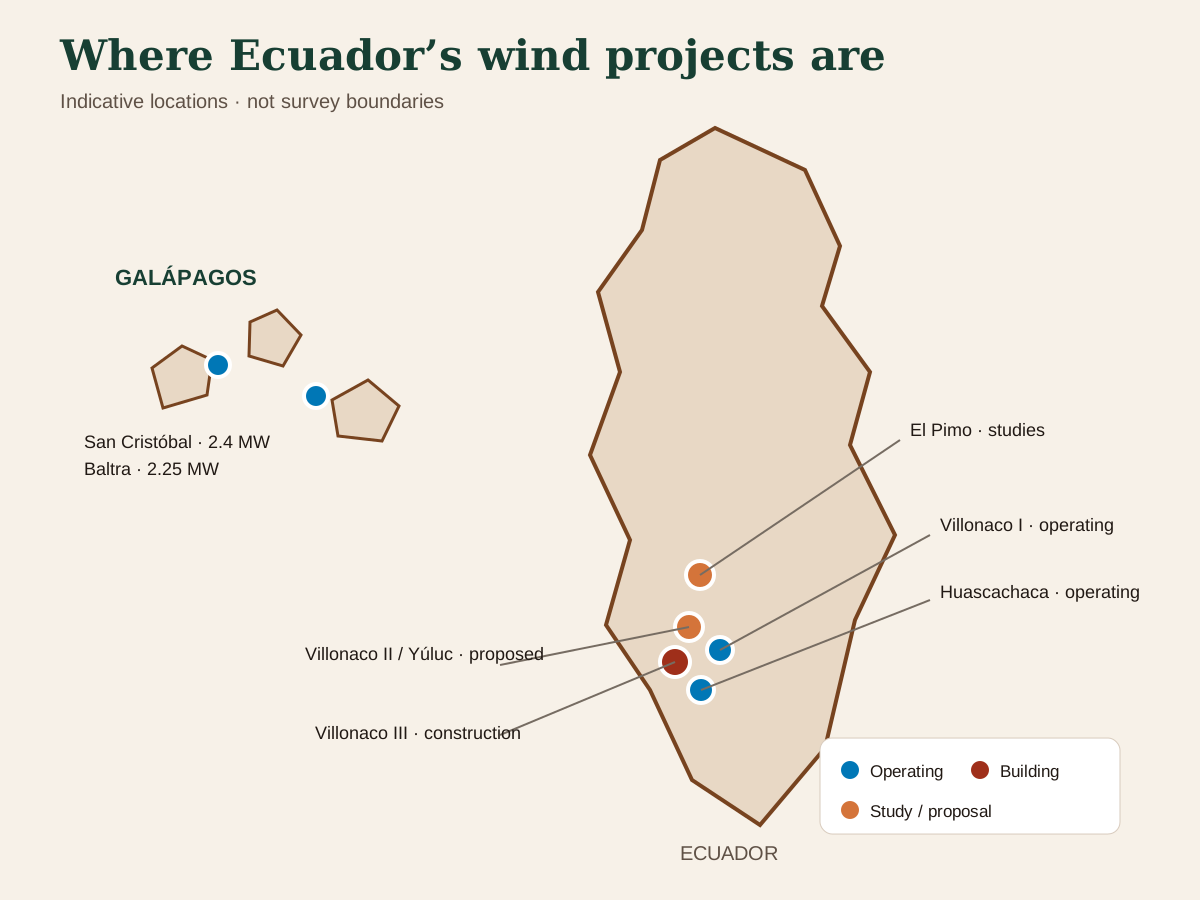
Ecuador’s strongest wind-development story is in the south. Loja contains Villonaco I, Huascachaca, the Villonaco II site and Villonaco III. The proposed El Pimo project lies farther north in Azuay. Galápagos has two small but historically important wind systems at San Cristóbal and Baltra.
How wind power fits Ecuador’s electricity system
Ecuador relies heavily on hydroelectricity. That produces comparatively low-carbon electricity in wet periods, but it also exposes the country to dry-season and drought risks. Wind cannot replace the country’s large dams by itself, but it can diversify the system. Wind conditions may remain useful when rainfall and reservoir inflows are weak, while thermal plants would otherwise burn imported or subsidized fuel.
A wind farm’s stated capacity is its maximum output under suitable conditions, not its constant production. Actual energy depends on wind speed, equipment availability, grid constraints and maintenance. This is why installed capacity in megawatts and annual generation in gigawatt-hours should not be treated as interchangeable figures.
Ecuador’s operating and developing wind farms
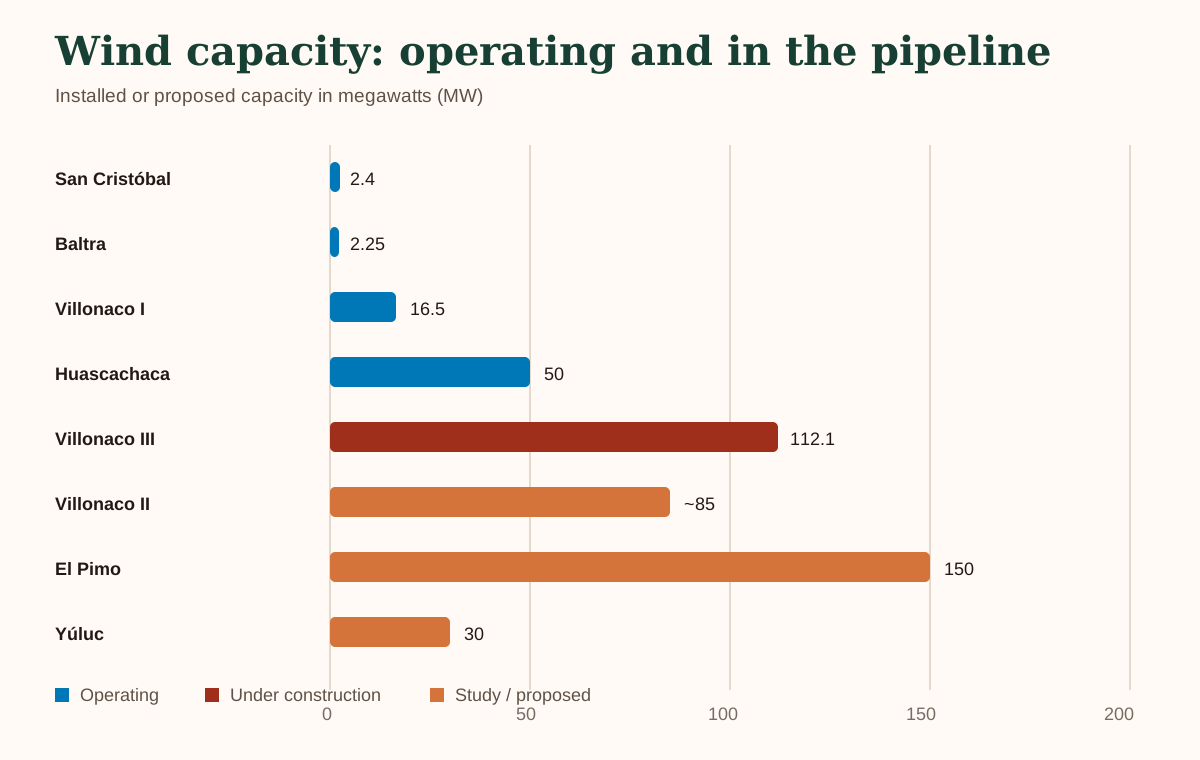
| Project | Province or system | Capacity | Status in September 2026 |
|---|---|---|---|
| San Cristóbal | Galápagos | 2.4 MW | Operating since 2007 |
| Baltra | Galápagos | 2.25 MW | Operating since 2014 |
| Villonaco I | Loja/Catamayo | 16.5 MW | Operating since 2013 |
| Minas de Huascachaca | Saraguro, Loja | 50 MW | Operating since 2023 |
| Villonaco III | Loja | 112.1 MW | Under construction |
| Villonaco II, Ducal–Membrillo | Loja/Catamayo | About 80–90 MW | Licensed and studied; awaiting investment and a final connection solution |
| El Pimo | Cuenca, Azuay | Proposed 150 MW | Prefeasibility and feasibility studies |
| Yúluc | Saraguro, Loja | Up to 30 MW | Early study; proposed extension near Huascachaca |
A short history of wind power in Ecuador
2007: San Cristóbal begins the modern story
The 2.4 MW San Cristóbal wind farm was Ecuador’s first operating wind project. Its three turbines supply an isolated island system where wind and solar reduce—but have not eliminated—the use of diesel generation.
2013: Villonaco I connects continental Ecuador
The original Villonaco plant brought utility-scale wind generation to continental Ecuador. Its 11 Goldwind turbines, each rated at 1.5 MW, follow approximately two kilometres of the Cerro Villonaco ridgeline west of Loja. The 16.5 MW state-owned plant entered commercial operation in 2013.
Villonaco I became notable for more than its altitude. Strong, consistent winds helped it substantially outperform its original generation estimates. CELEC reported a 63.8% capacity factor in 2015, an exceptional annual result for a wind project.
2014: Baltra adds wind to the Galápagos mix
Baltra’s three turbines provide 2.25 MW to the interconnected Baltra–Santa Cruz system. The islands also use solar generation, batteries and conventional thermal plants.
2023: Huascachaca becomes the largest operating wind farm
Minas de Huascachaca entered commercial operation in March 2023. Its 14 turbines provide 50 MW from San Sebastián de Yúluc in Saraguro canton. Until Villonaco III begins operating, Huascachaca remains Ecuador’s largest functioning wind farm.
2025–2027: Villonaco III moves from concession to construction
Villonaco III emerged from a public selection process opened in 2019. Environmental review and an investment agreement followed, but the schedule moved much more slowly than early announcements suggested. Its operating concession is counted from August 2025, and major civil and electrical works accelerated during 2026.
Villonaco I, II and III are different sites
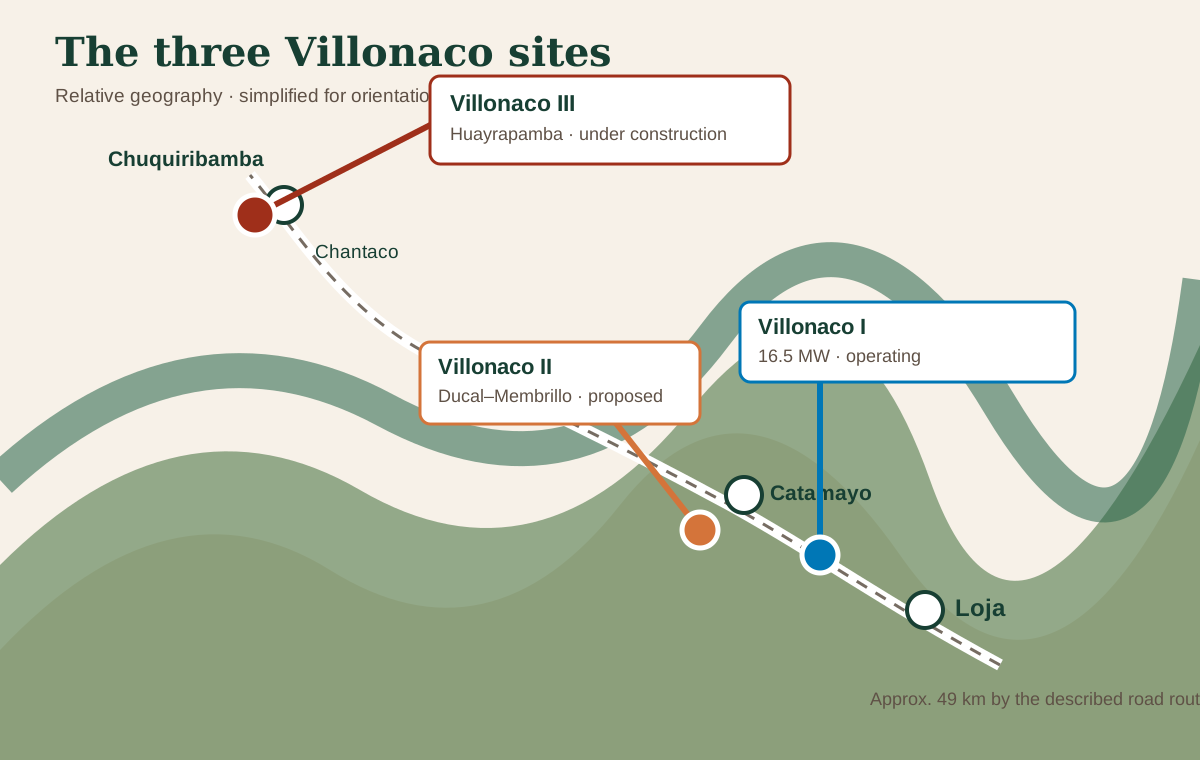
The numbering can be misleading. The projects are not three completed stages placed side by side.
- Villonaco I is the operating 16.5 MW plant on Cerro Villonaco.
- Villonaco II refers to the Ducal–Membrillo ridgeline. The project has studies and an environmental licence, but it did not move into financed construction with Villonaco III.
- Villonaco III is the much larger private project being built at Huayrapamba near Chuquiribamba and Chantaco.
What happened to Villonaco II?
Villonaco II and III were originally promoted together. The public selection process ultimately led to the Villonaco III development now under construction, while Villonaco II remained in the state project portfolio.
Villonaco II is more advanced than a speculative map location. Wind measurements were collected, designs contemplated approximately 23 turbines and the project obtained an environmental licence in 2022. However, its transmission alternatives still require further definition. CELEC’s concept involves long 230 kV connections and possible coordination with other planned generation. Without a developer, financing and a firm grid solution, it has not entered construction.
Officials now describe Ducal–Membrillo as an approximately 80–90 MW project available for private investment. Descriptions such as “ready to build” should be read cautiously: they do not mean that financing, procurement, transmission access and construction contracts are already complete.
Where Villonaco III is being built
The project occupies the Huayrapamba and surrounding mountain chain northwest of Loja, around the rural parishes of Chuquiribamba and Chantaco. Earlier official project documents describe a chain about 7.2 kilometres long with an average elevation close to 3,000 metres. The transmission corridor extends through a broader area before reaching the Loja substation.
That makes Villonaco III geographically separate from the original Villonaco plant. Chuquiribamba is roughly 49 kilometres from Loja along the described access route, although distances vary depending on the starting point and road used.
Why 57 blades?
Each of the 19 turbines uses three blades:
19 turbines × 3 blades = 57 blades.
Each blade is approximately 75 metres long. Transporting components of that size is a project in itself. The blades must travel from Puerto Bolívar through Pasaje, Santa Isabel, Girón, Cuenca, Oña, Saraguro and Loja before reaching the Chuquiribamba approach. Towers, nacelles and hubs use a different coastal and mountain route. The final approach brings the components together near the entrance to Chuquiribamba.
Arrival at the port therefore does not mean installation is complete. Customs clearance, road authorization, escorted convoys, transshipment, foundation completion, turbine assembly and electrical testing still follow.
What is being constructed?
The visible turbines are only one part of the plant. Villonaco III includes:
- Internal and upgraded access roads
- Nineteen turbine foundations and crane platforms
- Underground collector circuits
- A 33/138 kV step-up substation
- Approximately 24.5–25 kilometres of 138 kV transmission line
- Expansion and connection work at the Loja substation
- Control, communications and environmental-management systems
The Loja substation expansion is essential. A completed wind farm cannot supply the national system until its output can be safely transformed, transmitted and dispatched.
Who owns the power?
Villonaco I is state owned. Villonaco III is different: it is a private investment developed under a 25-year concession. The electricity is intended for the national interconnected system and will be sold through long-term agreements with state distribution companies.
This does not mean each electron is reserved for Loja. The plant will inject power into the wider grid. Statements comparing its annual production with the electricity demand of Loja and neighbouring areas illustrate scale, not an exclusive local allocation.
Is Villonaco the world’s highest wind farm?
No. Villonaco I operates at approximately 2,700–2,720 metres above sea level and Villonaco III’s historic project area averages close to 3,000 metres. These are high-altitude and technically demanding locations, but modern wind farms in Tibet operate at approximately 5,000–5,200 metres.
The original Ecuadorian distinction was narrower: Villonaco I combined its elevation with an unusually high average annual wind speed. It also achieved exceptional generation and capacity-factor results. Over time, those genuine achievements appear to have been simplified into the inaccurate claim that it is the world’s highest wind farm.
Benefits and trade-offs
Potential benefits
- Additional electricity without burning fuel during operation
- Greater diversity in a hydro-dominated electricity system
- Private investment in generation and transmission infrastructure
- Construction employment and demand for local services
- Road and access improvements that may have uses beyond the project
Issues that require continuing oversight
- Effects on birds and bats
- Noise and shadow flicker near inhabited areas
- Landscape change along mountain ridges
- Erosion, drainage and water protection during road construction
- Land agreements and community commitments
- Construction traffic, dust and road safety
- Restoration and decommissioning obligations at the end of project life
IDB Invest classifies Villonaco III as a Category B project: its environmental and social impacts are expected to be limited or manageable with established measures, but they still require monitoring and a formal action plan.
What comes next for Villonaco III?
- Complete customs clearance and move turbine components from Puerto Bolívar.
- Finish access roads, foundations and crane platforms.
- Assemble towers, nacelles, hubs and blades.
- Complete the project substation and transmission line.
- Connect to the expanded Loja substation.
- Test individual turbines and the plant as an integrated system.
- Obtain the approvals needed for commercial operation.
The stated target is commercial operation during 2027. Large energy projects regularly experience schedule changes, so progress should be judged by completed construction and grid-connection milestones rather than announcements alone.
The future of wind power in Ecuador
CELEC estimates that Ecuador has approximately 2,000 MW of wind-project potential and operates 21 monitoring towers across Loja, Guayas, Cotopaxi, Azuay, El Oro, Esmeraldas, Chimborazo and Bolívar. Resource measurement is only the first step. A viable wind farm also requires acceptable environmental and social impacts, road access, financing, a buyer for its electricity and transmission capacity.
The next major test after Villonaco III is likely to be El Pimo in Azuay. CELEC began procuring detailed prefeasibility and feasibility work in 2026 for a possible 150 MW project. ELECAUSTRO is also studying a smaller 30 MW Yúluc development near Huascachaca. Villonaco II remains available but needs an investor and a credible interconnection plan.
Older portfolios identify other promising locations around Ecuador, but a measured wind resource or a name in a planning document is not the same as a project under construction. Ecuador’s wind future will be determined less by the number of proposed sites than by how many projects complete the full chain from study to financing, community agreement, transmission and operation.
Sources and further reading
- CELEC: Villonaco I performance and operating history
- CELEC: Villonaco II / Ducal–Membrillo project profile
- IDB Invest: Villonaco III financing and project scope
- La Hora Loja: arrival and transport plan for the 57 blades
- ELECAUSTRO: Minas de Huascachaca
- ELECGALÁPAGOS: San Cristóbal and Baltra history
- CELEC: El Pimo feasibility studies
- CELEC: Ecuador’s wind-monitoring program and estimated potential