Featured
Ecuador's Women: Progress, Power and the Road Ahead
From pioneering professionals to business and political leaders, a century of change—and the challenges that remain.
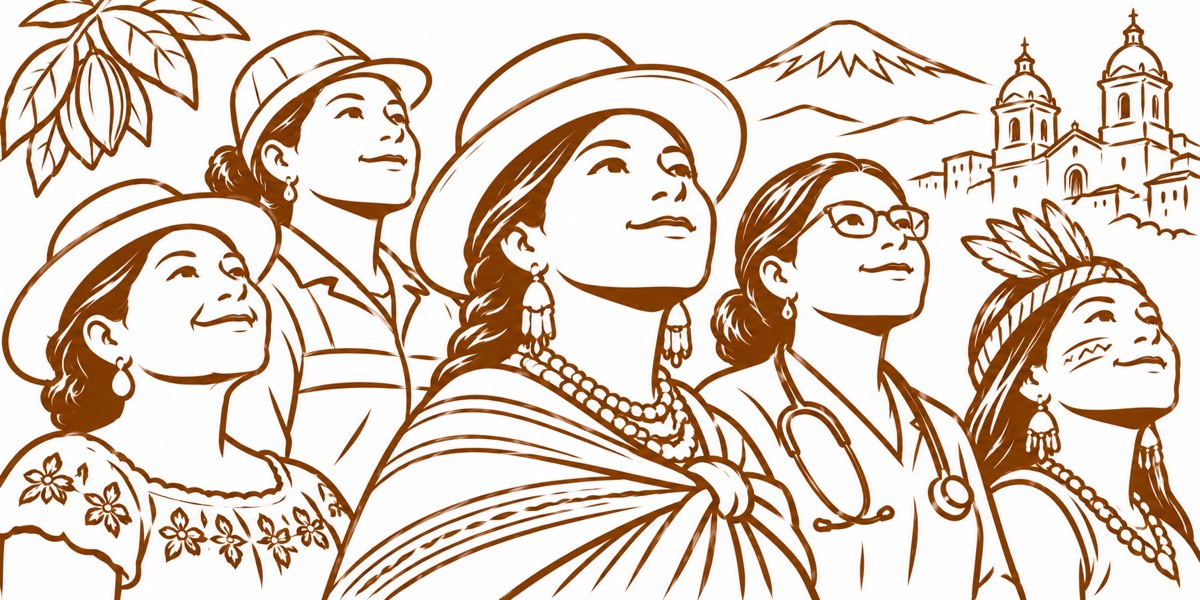
Across Ecuador, women are building businesses, leading institutions and taking on responsibilities that earlier generations struggled to access.
In Manta, a chef is developing new markets for traditional Manabí food. In the Amazon, women are turning agricultural knowledge into commercial opportunities. In law offices, hospitals, universities and government, women are exercising growing professional and political influence.
Their achievements reflect more than a century of change. But the progress has been uneven, and significant inequalities remain.
Building businesses and opportunities
For Manta entrepreneur Luciana Alvia, traditional cuisine is both a cultural inheritance and a business opportunity. A chef with marketing training, she operates Cevichería D'Lucy and is developing packaged ceviche products for wider distribution.
As El Diario reported in November 2026, Alvia was selected for an entrepreneurship distinction during Manta's cantonization celebrations.
In nearby Portoviejo, three women have demonstrated another route to business ownership. Belén Rivadeneira, Salma Romero and Alejandra Moreira began selling products through social media before establishing physical businesses. Their experiences, profiled by El Diario, show how digital commerce can help entrepreneurs develop a customer base before investing in premises and employees.
In Orellana, the Sacha Ayllu cooperative brings together 63 members producing and marketing products made from sacha inchi, a traditional Amazonian crop. Its SachaFit brand connects agricultural knowledge with processing and commercial distribution. The Integral REDD+ Programme has documented the cooperative's efforts to reach wider markets.
These enterprises reflect a broader trend. Ecuador's Global Entrepreneurship Monitor 2025 reported that women represented 52.23% of adults engaged in early-stage entrepreneurial activity.
Access to financing remains important. Government figures published in 2026 reported that women received $239 million in entrepreneurship loans through BanEcuador and CONAFIPS between January and September, 7.3% more than during the corresponding period of 2025.
From pioneers to professional leaders
A century ago, Ecuadorian women were still challenging restrictions on education, professional careers and political participation.
Matilde Hidalgo de Procel, born in Loja in 1889, became Ecuador's first woman to earn a medical degree. In 1924, she became the first woman to exercise the vote in Latin America, connecting professional achievement with political rights.
Today, Ecuadorian women work throughout medicine, law, engineering, education, science and corporate management.
Belén Martínez, founder of BEMART, represents a newer generation of technical entrepreneurs. Her company develops medical applications of three-dimensional printing, bringing together engineering and specialized healthcare. Her work was profiled by Vistazo in March 2026.
In the legal profession, women increasingly occupy senior roles, although advancement into leadership remains uneven. Ecuadorian legal professional Ximena Bautista discussed both the progress and continuing obstacles in an interview published by Lemontech.
Women also direct companies and manage large workforces. Yet INEC's 2024 structural business survey found that women accounted for just 33.4% of employment in the medium-sized and large companies surveyed. Average monthly remuneration was $941.50 for women and $966.40 for men, although those figures do not compare identical jobs.
A changing political landscape
Women's political representation has undergone a remarkable transformation since Matilde Hidalgo cast her vote in 1924.
Rosalía Arteaga briefly held Ecuador's presidency in 1997. Nina Pacari became the country's first Indigenous woman foreign minister in 2003. Women have since occupied senior government positions and competed for the presidency.
Electoral reforms have also increased women's participation in legislative candidacies.
Women held approximately 41% of National Assembly seats after the 2023 election, rising to around 45% following the 2025 election.
Local government tells a different story. Women won only 18.6% of mayoralties and 30.4% of provincial prefectures in the 2023 elections.
That contrast is significant. Women are approaching parity in the national legislature but remain substantially underrepresented in local executive offices, where decisions about infrastructure, services and public investment directly affect communities.
Greater representation also does not mean women share the same political views. Ecuador's female politicians represent different parties and constituencies, and their individual records vary.
Progress, inequality and the next generation
The distance travelled since Matilde Hidalgo's time is considerable. Women now own businesses, practise specialized professions, direct institutions and occupy a substantial share of the national legislature.
But opportunity is not evenly distributed.
Many small enterprises operate with limited capital. Women remain underrepresented in some senior positions, while unpaid responsibilities for children and other relatives can restrict opportunities for employment and professional advancement.
Geography, income, education and access to credit also matter. A professional in Quito, a market trader in Manabí and an agricultural producer in the Amazon may face very different circumstances.
The next stage of progress will depend partly on access to financing, technical education, professional advancement and political opportunity. Digital commerce offers new ways to reach customers, while electoral rules may open more doors for women seeking public office. Neither guarantees success.
Ecuador's women have moved from challenging the right to participate to exercising influence across business, professional and political life.
The question for the years ahead is not simply how many women participate, but how many have the resources, opportunities and authority to shape the country's future.