Standard
Artificial Intelligence Enters Ecuador's Classrooms — But Can Every Student Benefit?
Ecuador is introducing artificial intelligence into public education through an ambitious digital learning programme. The technology promises new opportunities for teachers and students, but unequal access to computers and reliable internet could leave some communities behind.
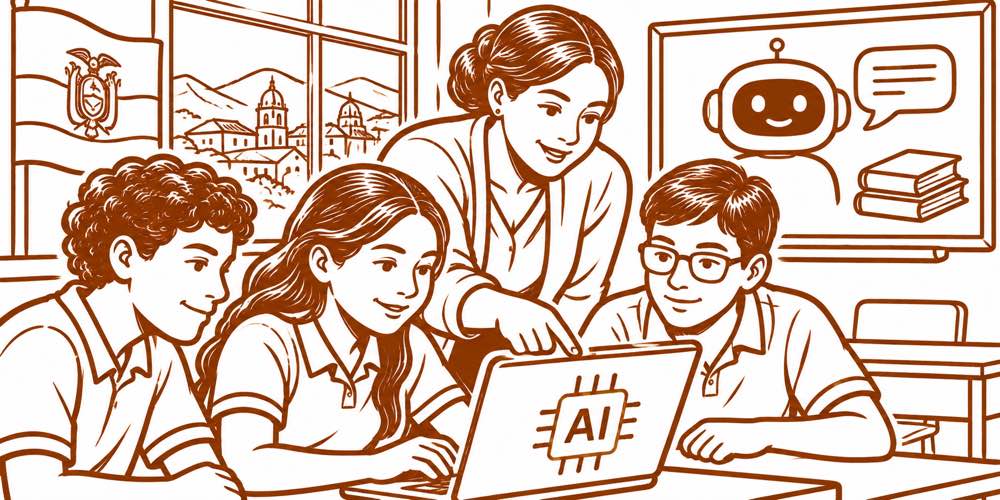
A New Chapter for Ecuador's Classrooms
A student in Quito may soon be able to use artificial intelligence to work through a difficult mathematics problem, while a student in a rural community could struggle to access the same technology. That contrast is at the centre of Ecuador's latest effort to modernize public education.
The government's Aula Digital programme aims to bring digital learning resources to 2.8 million students and 165,000 teachers. Developed with Google for Education and the National Telecommunications Corporation (CNT), the initiative will introduce familiar applications such as Google Classroom alongside AI tools including Gemini and NotebookLM.
The programme forms part of a national digital education plan extending to 2029, with an announced government investment of $50 million. Its first phase focuses on secondary-school students and public higher technical institutes, with broader access planned as implementation progresses.
A New Tool for Teaching and Learning
For teachers, AI could help prepare lessons, adapt exercises to different learning levels and reduce time spent on routine administrative tasks. Students could use it to explore unfamiliar subjects, receive additional explanations and practise skills outside the classroom.
The technology also raises questions about how students learn. AI-generated answers are not always accurate, and relying on them without understanding the underlying material can undermine the skills education is intended to develop.
At an education conference in Quito in October, specialists discussed the need for teacher training, clear institutional guidance and safeguards for students. Daniela Trucco, a social affairs officer with the United Nations Economic Commission for Latin America and the Caribbean (ECLAC), cautioned that evidence about the effects of generative AI on learning outcomes remains limited.
The Challenge Beyond the Screen
Ecuador has made considerable progress in connecting households to the internet, but access remains uneven. According to the National Institute of Statistics and Census (INEC), 76.6% of urban households had internet access in 2025, compared with 58.7% in rural areas.
Having an internet connection does not necessarily mean having a suitable computer. Only about one-third of Ecuadorian households had a desktop computer, laptop or tablet, with ownership considerably lower in rural communities. For students expected to complete assignments and use digital learning platforms, the available equipment can make a substantial difference.
The government is addressing some of these gaps through a separate rural technology and connectivity programme supported by $39.58 million in financing from the Development Bank of Latin America and the Caribbean (CAF). The programme includes computers, classroom equipment and expanded satellite internet connections, with CNT and Starlink involved in reaching remote schools.
In 2025, the Education Ministry reported providing technology kits to rural institutions and satellite connectivity to 1,000 schools. Further equipment distribution and connectivity expansion are part of the 2026 programme.
Preparing Teachers for the Change
Equipment and connectivity are only part of the challenge. Teachers will need to understand how to use AI effectively, recognize its limitations and help students distinguish reliable information from convincing but incorrect answers.
Ecuador's Ministry of Education has already published guidance on responsible AI use. The wider rollout of Aula Digital will test how well those principles can be incorporated into everyday teaching, particularly in schools with fewer technological resources.
The programme could bring new educational opportunities to students across Ecuador. Its success will depend not only on the technology available, but also on whether teachers and students in rural and lower-income communities can use it as effectively as those in better-connected schools.
Sources: - El Universo — Aula Digital programme - Primicias — programme rollout and rural connectivity - Revista Gestión — AI and Ecuador's digital divide - INEC — official 2025 technology statistics