Standard
From Quito to CERN: Two Ecuadorian Students Help Upgrade the World's Largest Particle Collider
At just 21, two university students from Ecuador are developing software for one of the world's most ambitious scientific projects, working alongside international researchers before completing their undergraduate degrees.
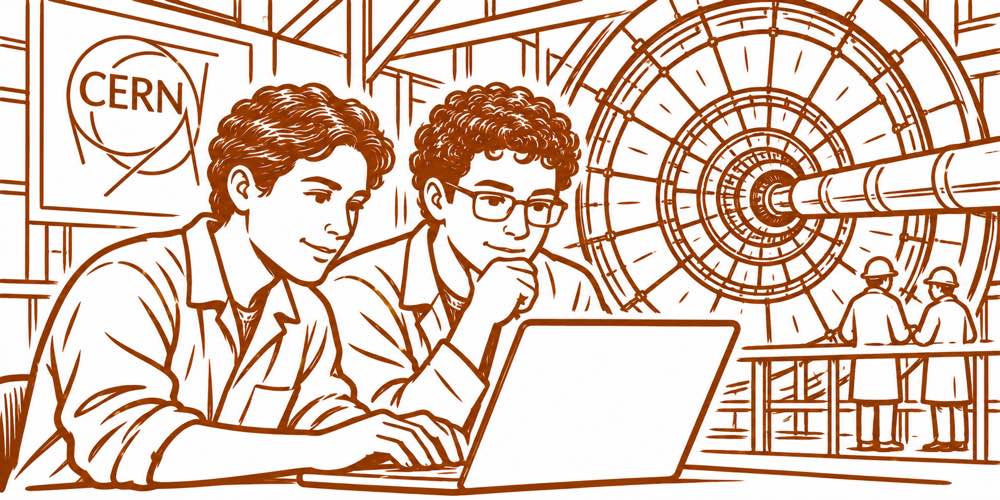
From Childhood Curiosity to CERN
Ariel Dax Navarrete began learning Linux when he was just six years old. Fifteen years later, those early computer skills have helped take him from a university classroom in Quito to CERN, the European particle physics laboratory near Geneva, Switzerland.
Navarrete, 21, studies Computer Science at Ecuador's Escuela Politécnica Nacional (EPN). Together with fellow student Emilio Camino, also 21 and studying Software Engineering, he is contributing to a project connected to the Large Hadron Collider, the world's largest and most powerful particle accelerator.
Both students are still in their sixth semester of university. Yet in October 2026, they travelled to Switzerland to present their work to an international team of physicists and engineers. Their involvement began much earlier, in May 2025, under the guidance of EPN professor Diana Martínez Mosquera.
Helping Scientists Handle a Flood of Data
The Large Hadron Collider accelerates particles to nearly the speed of light and brings them into collision. Scientists examine the results to understand the fundamental building blocks of matter. Research at CERN led to the discovery of the Higgs boson in 2012.
Those experiments generate enormous amounts of information, and managing that data is an essential part of modern particle physics. Navarrete and Camino are working with the CMS experiment, one of the collider's major particle detectors, on software associated with its BRIL system, which monitors beam conditions and radiation.
Their task is to help move information from the detector's online systems into offline infrastructure, where it can be organized, stored and analysed. The software must handle data efficiently and reliably so researchers can use the information produced during experiments.
During their October visit, CERN specialists reviewed the students' work and requested improvements. According to Navarrete, subsequent testing showed performance four times better than the initial benchmarks.
Learning Alongside International Researchers
Working at CERN presented challenges beyond writing software. Camino recalled feeling intimidated during the first meetings, surrounded by experienced scientists with doctorates and years of research experience. The discussions also took place entirely in English.
With experience, both students became more comfortable contributing directly to the international team. Their professor described how they progressed from relying on her support during meetings to communicating and working independently with CERN researchers.
Navarrete's early interest in Linux also proved valuable. Open-source software is widely used in scientific computing, and his familiarity with it helped prepare him for the technical environment at CERN.
The collaboration has given both students experience developing software for a scientific project in which accuracy, reliability and performance are essential.
A Contribution from Ecuador
The Large Hadron Collider is being upgraded to allow scientists to study more particle collisions, increasing the demands on its detectors and computing systems. The work being carried out by Navarrete and Camino contributes to the software infrastructure supporting that research.
On November 11, EPN highlighted their participation in the CMS experiment, describing their contribution to systems that organize, transfer, transform and store scientific data.
For the two students, the experience has brought an opportunity to work on advanced international research before completing their university degrees. For EPN, it demonstrates how collaboration with institutions abroad can give Ecuadorian students a role in scientific projects that depend on expertise from around the world.
Sources: Primicias — student interviews · Escuela Politécnica Nacional · CERN