Standard
From Used Oil Filters to an International Science Prize: Galápagos Students Turn Waste into Innovation
Three teenagers from Santa Cruz have transformed discarded automotive parts into an experimental cooking stove, winning international recognition in Brazil and opening the door to further scientific competitions.
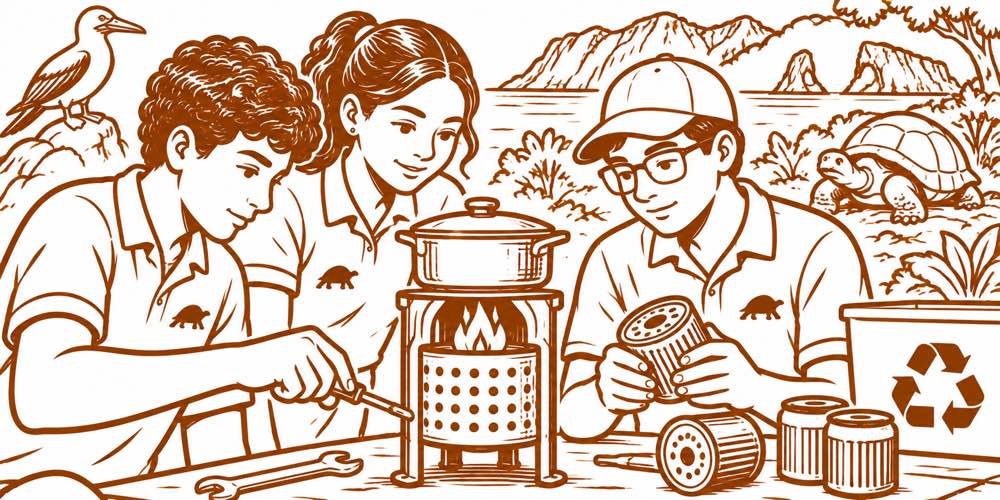
An Invention Born in the Galápagos
On Santa Cruz Island, three secondary-school students noticed a problem familiar to local mechanics: used automotive oil filters accumulating as waste. With limited facilities for processing these materials on the islands, the students began exploring whether the discarded parts could be given another purpose.
The young inventors are Emilia Brito, Sebastián Villavicencio and Robert Cruz, as identified in a November 11 report by El Comercio. All three attend the Unidad Educativa Tomás de Berlanga. Emilia and Sebastián are 16, while Robert is 15.
Their answer was an experimental stove built from ten used oil filters, supported by a small fan, solar panel and portable battery. The project earned third place in the international category of FeNaDANTE 2026, a science and technology fair in São Paulo, Brazil.
Working under the guidance of physics and mathematics teacher Javier Zöller, the students spent approximately two years developing the project. Much of their experimental work took place at Robert's home rather than in a fully equipped laboratory.
A $60 Prototype That Works
The stove uses discarded oil filters to form its combustion chamber. A small electrically powered fan pushes air into the flame, while a solar panel and portable battery supply electricity to the fan.
Each student contributed different skills. Emilia organized materials and maintained the experimental records, Robert handled mechanical construction using tools available at his home, and Sebastián worked on the electrical system.
In their best reported test, the students heated 650 millilitres of water from 29°C to 98°C in 11 minutes, using a mixture of filtered waste oil and industrial alcohol. They conducted 28 experiments examining heating performance, fuel consumption, battery life and flame stability.
The prototype cost approximately $60 to construct, largely because the team reused available materials. Some components, including a specialized fan, had to be ordered from outside the islands.
The stove remains experimental. It has not yet been tested for cooking meals, and further work is needed to measure emissions, evaluate safety and compare its efficiency with conventional cooking equipment.
From Santa Cruz to the World
The project also illustrates the difficulties of conducting scientific research in the Galápagos. Laboratory equipment and electronic components are often unavailable locally, requiring schools to obtain supplies from mainland Ecuador.
Reaching the competition in Brazil was considerably more expensive than building the stove. According to the school, travel and participation cost approximately $3,500 per student, financed through contributions from families, the school and private supporters.
Their success in São Paulo earned the team invitations to two further international science events planned for 2027, one in Indonesia and another in Brazil. Their teacher also received a special award recognizing his contribution to student research.
The students now hope to improve the design, investigate its environmental performance and explore its potential as an outdoor cooking stove. Their achievement follows other international science-fair successes by students from their school, which has developed a research programme encouraging young people to investigate problems in their own communities.
Sources: El Comercio — November 11, 2026 · El Universo — November 4, 2026