Cover
From Manta to a U.S. Courtroom: Ecuadorian Fishermen Demand Answers
On March 2, 2026, sixteen fishermen sailed from Manta aboard La Negra Francisca Duarte II, expecting to spend about two weeks fishing near the Galápagos Islands. They were heading home on March 17 when, according to the crew, explosive drones struck their vessel and set it ablaze. Two fishermen suffered serious burns, and the men escaped into smaller boats as flames spread through their fishing vessel. Their ordeal, they say, continued when armed personnel detained them, restrained and hooded them, and eventually transferred them to authorities in El Salvador.
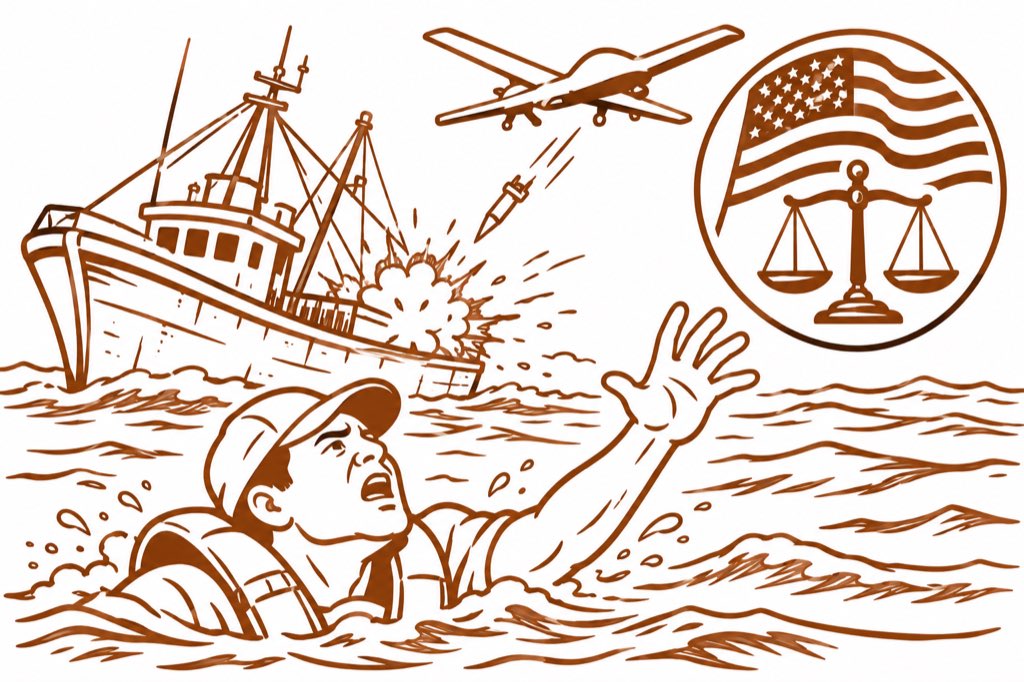
Eight months later, their experience has reached an unlikely destination: a federal courtroom in Pittsburgh, Pennsylvania. On November 16, the sixteen fishermen and the vessel's owner filed a civil lawsuit against the United States, alleging that American personnel attacked their boat and unlawfully detained and mistreated its crew. The case raises a question that has remained unanswered since March: who attacked the fishermen, and why?
Inspected by Ecuador's Navy — then attacked
One of the most important pieces of evidence comes from Ecuador's own Navy. On November 20, Primicias reported details of an inspection record documenting an encounter between the fishing boat and the Ecuadorian patrol vessel Isla San Cristóbal on March 17, shortly before the reported attack.
According to the report, naval personnel inspected the vessel for approximately two hours and found no illicit cargo or unauthorized fuel. They issued a citation concerning personnel who had not been properly declared, then allowed the fishermen to continue toward Manta. The inspection does not establish what happened afterward, but it independently confirms an important part of the crew's account: Ecuadorian authorities had examined their vessel shortly before it was reportedly attacked.
Later that day, according to the fishermen, drones approached and explosions tore through the boat. Survivors interviewed by Human Rights Watch described flames spreading across the vessel. One recalled seeing a damaged white drone with four propellers on the deck, while another explosion reportedly injured a crew member attempting to release a smaller boat. The fishermen abandoned their burning vessel, but their ordeal was far from over.
They say a large blue-and-white ship approached, carrying armed personnel in military-style uniforms. Some survivors reported American flag insignia, while others recalled hearing English. According to the federal complaint, the men were taken aboard, restrained, hooded and held under armed guard. They allege they received little food or water and were subjected to degrading treatment before being transferred to Salvadoran authorities. Human Rights Watch reported that Salvadoran officials described receiving sixteen shipwreck survivors handed over by U.S. personnel.
The two seriously injured fishermen returned to Ecuador in late March. The remaining crew members arrived home in groups between April 3 and April 10. Their fishing vessel was lost.
What the independent evidence reveals
Human Rights Watch began investigating the incident months before the lawsuit was filed, interviewing survivors and witnesses, examining photographs and medical records, and comparing vessel-tracking information with satellite observations. Its findings provide important corroboration for parts of the fishermen's account.
The fishing boat's last recorded position was transmitted at 12:41 p.m. on March 17. At 1:02 p.m., a NASA satellite detected a thermal anomaly consistent with a fire near that location. Crew members aboard another Ecuadorian fishing vessel, the Solavil, also reported seeing black smoke and a boat burning in the same general area.
Researchers reviewed photographs of the injured fishermen and supporting medical evidence. An independent medical expert found that one crew member's injuries were consistent with his description of contact with a drone propeller. Together, the satellite observations, witness accounts and medical findings provide substantial support for the reported fire, injuries and location of the incident.
What they do not establish is equally important. The independent evidence has not conclusively identified who launched the drones or the personnel who detained the fishermen. Those questions remain central to the lawsuit.
The reported CIA connection
In August, The Washington Post published an investigation reporting that attacks on Ecuadorian fishing vessels were part of a covert CIA programme. The newspaper examined surveillance-aircraft movements and cited information from a person familiar with the operation, pointing toward American intelligence involvement in incidents near the Galápagos.
That reporting is distinct from the Trump administration's publicly acknowledged military strikes against vessels it identifies as involved in drug trafficking. Since September 2025, the administration has described those operations in the Caribbean and eastern Pacific as part of a campaign against designated narcoterrorist organizations. Human rights groups and legal specialists have challenged the legal justification for using lethal military force against suspected traffickers.
The CIA operates under a different framework, and covert intelligence activities are not necessarily publicly acknowledged in the same way as military operations. The Washington Post investigation raised serious questions about American intelligence involvement, but it was neither a public admission of CIA responsibility nor a court finding identifying the attackers.
The U.S. Defense Department and Coast Guard previously denied knowledge of or involvement in the incidents investigated by Human Rights Watch, while the Pentagon declined to comment on the pending lawsuit. The fishermen maintain that they were ordinary fishing workers, not drug traffickers. Their complaint alleges that the United States was responsible for both the attack and their subsequent detention.
Why a courtroom in Pennsylvania?
Pittsburgh might seem an unlikely destination for a dispute involving fishermen from Manta and a vessel lost in the Pacific Ocean. None of the plaintiffs lives in Pennsylvania, and the reported attack happened thousands of kilometres from the United States. Yet their lawyers filed the case in the U.S. District Court for the Western District of Pennsylvania, relying on provisions of American maritime law.
The complaint invokes the Suits in Admiralty Act and the Public Vessels Act, federal statutes that permit certain maritime claims against the United States government. The lawyers argue that because the plaintiffs are foreign nationals without homes or business offices in the United States, the relevant provisions allow them to bring their claims in any federal judicial district. They also point to western Pennsylvania's experience handling maritime disputes involving its navigable rivers and the port of Erie, on Lake Erie.
The plaintiffs are seeking compensation for their injuries, alleged mistreatment and the loss of their vessel. Their lawyers have valued the claim at US$5 million, although the complaint leaves the amount of damages for the court to determine. They also request an order ending U.S. lethal strikes against boats in the Caribbean and Pacific.
The court has not determined whether the United States is responsible. Before reaching that question, it must consider whether the claims can proceed under the laws governing maritime lawsuits against the federal government.
Three vessels, unanswered questions
La Negra Francisca Duarte II was not the only Ecuadorian fishing vessel involved in unexplained incidents near the Galápagos during the first months of 2026. On January 20, the Fiorella disappeared, leaving eight crew members missing. Two fishermen working away from the main vessel reported seeing smoke near its last known position. On March 26, survivors of the Don Maca reported another attack involving explosive drones, injuries, detention by armed personnel and a subsequent transfer to Salvadoran authorities.
Human Rights Watch investigated all three incidents, finding similarities in survivors' accounts but no conclusive identification of the attackers or explanation for the Fiorella's disappearance. The organisation also examined criminal-record certificates for 46 men associated with the vessels. Four had criminal records, but none involved drug trafficking or violent offences. Those records cannot establish what cargo any vessel carried, although they provide context for allegations that the crews were engaged in serious criminal activity.
The incidents have particular significance in Manabí, where fishing supports families and entire coastal communities. Manta, San Mateo and Jaramijó are among the places connected to the affected crews. A fishing boat represents far more than its purchase price: it provides employment at sea and business for those supplying fuel, ice, equipment, repairs and services onshore. When a vessel is lost, the economic consequences extend beyond the people who were aboard.
Captain José Hernán Flores Vilez told Reuters that the fishermen decided to sue because they had lost the boat on which they depended and felt they had received no assistance from Ecuadorian authorities. Their case faces substantial legal obstacles, and the proceedings could be challenged or dismissed without resolving every question. They may also bring new evidence about who operated the drones, who controlled the vessel that detained the crew and why the fishing boat was targeted.
For sixteen men who left Manta expecting an ordinary fishing voyage, the consequences are already substantial: serious injuries, the loss of their boat and months of uncertainty. They went to sea to earn a living. Now they are asking a court thousands of kilometres away to determine who was responsible for what happened to them.
Sources
- Federal complaint — *Flores Franco et al. v. United States*, November 16, 2026
- Human Rights Watch — *A Dangerous Partnership*, July 21, 2026
- Reuters — Ecuadorian fishermen sue Trump administration, November 16, 2026
- Associated Press — Fishermen from Ecuador sue Trump administration, November 18, 2026
- The Washington Post — Covert CIA programme investigation, August 13, 2026
- Primicias — Ecuadorian Navy inspection report, November 20, 2026
- ABC News Australia — Ecuadorian fishermen sue U.S. government, November 20, 2026