Featured
What Will Ecuador Grow Next? Inside the Country's New Farming Frontier
Drive through parts of Ecuador's pitahaya-growing country after dark and you may encounter an extraordinary sight: rows of cactus plants illuminated by electric lights, turning agricultural fields into glowing grids against the night sky. The lights aren't there to help farmers harvest after sunset. They are used to influence the plants' response to daylight, encouraging flowering and helping growers manage when their fruit will be ready for market.
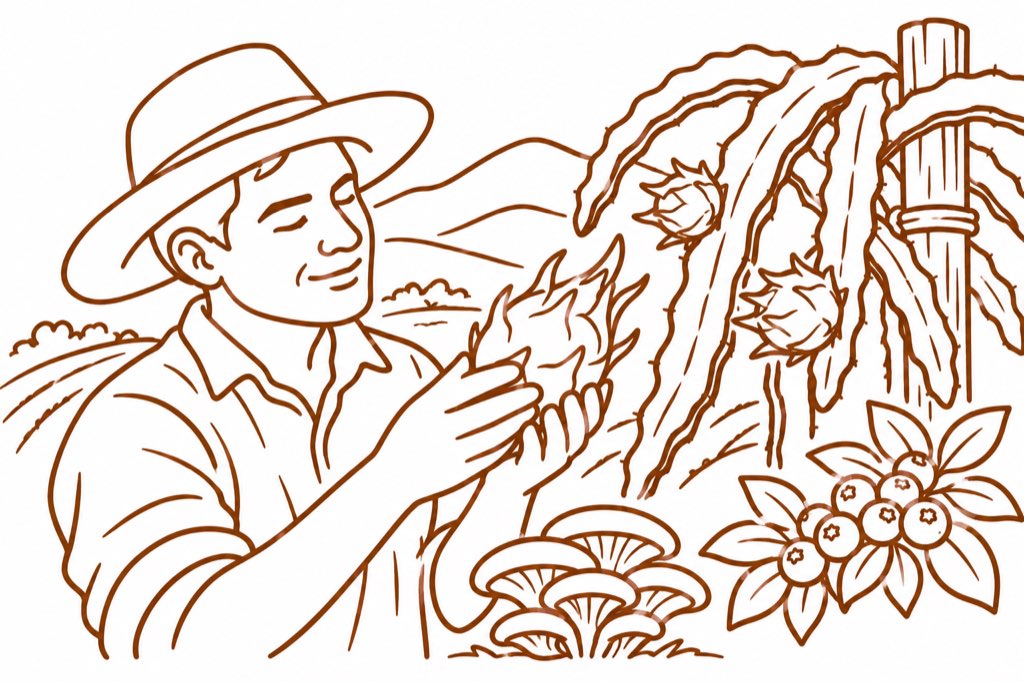
It's a striking example of how Ecuadorian agriculture is changing. A country already famous for bananas, cacao and flowers is finding new opportunities in fruits that were once unfamiliar to most consumers, while growers experiment with technologies and techniques that would have seemed unusual on a traditional farm.
From wild cactus to international export
The yellow pitahaya of Palora, in Morona Santiago, has become one of Ecuador's agricultural success stories. Beneath its golden skin is sweet white flesh dotted with tiny black seeds, produced by a climbing cactus whose spectacular flowers open at night. According to Ecuador's Agriculture Ministry, its commercial history in Palora began in 1968, when farmer Félix Miguel Zabala discovered a wild cactus bearing an unfamiliar but delicious fruit.
Over the following decades, local growers developed plantations and established markets far beyond Ecuador. Today, yellow pitahaya from the Amazonian foothills and red varieties cultivated along the Coast are part of an international export industry. Manabí has become an important growing area for red pitahaya, demonstrating how a crop associated with one region can find opportunities in another.
The industry's success has also brought new challenges. An analysis of customs data published in November 2026 found that Ecuador was exporting more pitahaya while receiving a lower average price per kilogram. As production expands, growers must balance the opportunities of a larger market against increasing competition and pressure on prices.
Artificial lighting is one response to the need for greater control over production. Research in Santa Elena and Guayas has explored how supplemental light can influence flowering in red pitahaya, potentially helping farmers schedule harvests rather than depending entirely on natural flowering cycles. The glowing fields are an unusual sight, but the principle is familiar to agriculture everywhere: finding ways to produce the right crop at the right time for the market.
Blueberries, mangosteen and the search for new markets
Blueberries might bring to mind cool Canadian summers or farms in the northern United States, yet Ecuadorian growers are now producing them commercially. The plants can require considerable ingenuity. Rather than growing directly in ordinary farm soil, many are cultivated in containers filled with coconut fibre, with water and nutrients delivered through carefully managed irrigation systems. Protective coverings can help control rainfall and humidity.
Diego Garzón Zaldumbide, president of the Ecuadorian Federation of Blueberry Producers and Exporters, told Forbes Ecuador in August 2026 that the country's combination of altitude, sunlight and temperature can produce berries with attractive size and flavour. An industry that began with three pioneering producers has expanded to more than 35 businesses and growers across ten provinces, including Manabí and Santa Elena.
Neighbouring Peru is already a major force in the international blueberry trade, while Ecuador remains a newcomer. Its growers are experimenting with varieties suited to different local climates, and they have an advantage beyond export possibilities: Ecuadorian supermarkets offer customers much closer to home. For a developing industry, building domestic demand can be as important as finding buyers overseas.
Other growers are looking toward fruits with an entirely different history. Mangosteen, originally from Southeast Asia, is about the size of a small orange, with a thick purple rind enclosing segments of delicate white flesh. Its sweet, slightly tangy flavour has long been appreciated in Asia, but it remains unfamiliar to many Ecuadorian consumers.
In 2025, Ecuador began exporting mangosteen to markets including Canada, France and the United Kingdom. One company involved, Equadragonfruit, began as a pitahaya exporter before expanding into other products. General manager Fernando Lozada told El Comercio in September 2026 that the company was handling twelve different fruits, including mangosteen grown in La Concordia and Los Bancos.
The company has found customers overseas, including Asian communities already familiar with the fruit. That offers an interesting lesson in agricultural marketing: introducing an unfamiliar crop to Ecuador does not necessarily mean finding an unfamiliar customer abroad. Sometimes the market already exists, and the challenge is establishing a reliable source of supply.
The same exporter is helping renew interest in gulupa, a small purple passion fruit with fragrant golden pulp and a sharp, refreshing flavour. Unlike mangosteen, gulupa has deep roots in tropical America. Equadragonfruit sources it from areas including Atahualpa, north of Quito, and exports it to Spain.
Lozada reported that some farmers who had abandoned gulupa cultivation were returning as demand improved. The company has also expressed interest in longer-term purchasing arrangements that could give growers greater confidence about where their harvests will go. In this case, agricultural innovation is less about introducing something new than rediscovering the commercial potential of a familiar regional crop.
Farming without traditional fields
Not every new opportunity involves orchards, plantations or international shipments. In parts of Ecuador, producers are learning to cultivate mushrooms in sheltered spaces filled with shelves or growing bags. Oyster mushrooms emerge from prepared organic material, their broad caps spreading in clusters that look quite unlike anything growing in a conventional field.
Mushrooms can be cultivated in relatively small spaces, using carefully prepared substrates instead of ordinary soil. Growers manage moisture, temperature and ventilation, making the process as much about controlling conditions as tending a traditional crop.
In June 2026, farmers from Cotogchoa, in Rumiñahui canton, and Amaguaña, near Quito, attended a mushroom-growing workshop organised by the Agriculture Ministry and Granja Integral Terranostra. Participants learned to prepare growing materials, introduce fungal cultures and harvest edible mushrooms. One participant, Rosa Quinga, explained that the training provided access to knowledge that would otherwise have been expensive to obtain privately.
The possibilities are different from those offered by pitahaya exports or commercial blueberries. Mushroom cultivation can provide additional income and locally produced food without requiring extensive farmland, although it remains an emerging activity rather than a major Ecuadorian export industry.
Together, these developments reveal something important about Ecuador's agricultural future. Its varied geography, from humid Amazonian lowlands and warm Pacific plains to cool Andean valleys, offers an extraordinary range of growing conditions. But climate alone does not create a successful crop. Farmers need technical knowledge, suitable varieties, investment, dependable buyers and prices that make production worthwhile.
The illuminated pitahaya fields may be the most memorable symbol of this ingenuity: a cactus once found growing wild in the Amazon has become an international export crop whose flowering can now be influenced by artificial light. Elsewhere, blueberries grow in coconut fibre, Asian mangosteen finds new markets, farmers return to gulupa and mushrooms emerge from shelves instead of fields.
Ecuador's next agricultural success may already be growing somewhere unexpected.
Sources
- Universidad ECOTEC — Artificial lighting and flowering in red pitahaya, Santa Elena
- REDI/CEDIA — Artificial lighting experiment in Guayas
- INIAP — Manual del Cultivo de Pitahaya para la Amazonía Ecuatoriana
- Ministry of Agriculture — Pitahaya production and history
- Forbes Ecuador — El arándano ecuatoriano, el superfood del futuro
- El Comercio — Ecuador exports mangosteen and gulupa
- Ministry of Production — Ecuador's expanding tropical fruit exports
- Ministry of Agriculture — Mushroom cultivation training