Standard
Reading Ecuador's DNA: Why Local Genetics Could Change Medicine
What if a blood test could reveal important clues about cancer? Or a genetic study in Manta could help researchers understand why some people develop Parkinson's disease while others do not?
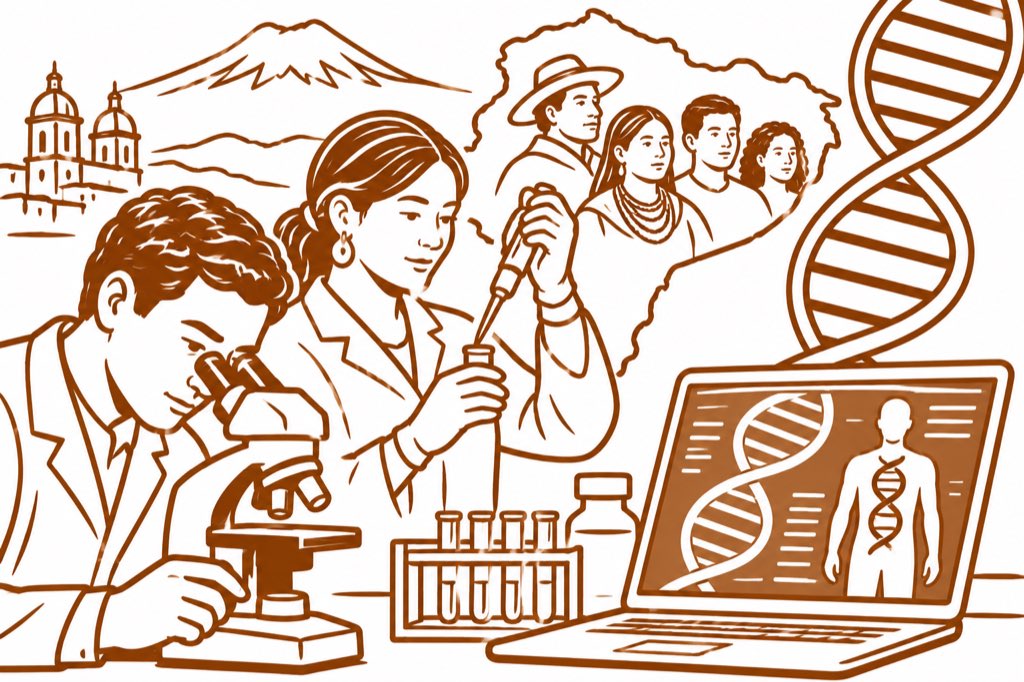
Scientists in Ecuador are exploring both possibilities as part of a growing movement toward personalized medicine — using information about a patient's genes, alongside conventional medical tests, to improve diagnosis and treatment. But their work addresses a problem that extends far beyond Ecuador: much of what scientists know about human genetics comes from studying populations that do not fully represent the world's diversity.
The missing pieces in the world's genetic picture
For decades, genetic research has disproportionately concentrated on people of European ancestry. As a result, the enormous databases scientists use to investigate inherited diseases, cancer risks and responses to medication do not fully represent the world's population. That matters because genetic variations differ in frequency between populations, and a marker that helps predict disease risk in one group may be less useful in another.
Ecuador offers an important opportunity to help address that imbalance. Its population includes people with Indigenous, Afro-Ecuadorian, European and mixed ancestral backgrounds, including Montubio communities with their own complex histories. By studying genetic variations among Ecuadorians, researchers can begin filling gaps in international databases while developing knowledge that may eventually improve medical care at home.
At Universidad UTE in Quito, the VARIOMA Ecuador project is working to build that knowledge by investigating genetic variants associated with disease. The objective is not to identify a single Ecuadorian genetic profile, but to understand the diversity of genetic variations found among individuals and communities and how those differences may influence health.
Could a blood test reveal cancer?
One promising example comes from thyroid cancer research at Universidad UTE. Doctors investigating a suspicious thyroid nodule commonly use a fine needle to collect cells for examination, but researchers are exploring whether a blood sample could provide additional information without requiring another tissue procedure.
The technique, called liquid biopsy, looks for fragments of DNA released by tumours into the bloodstream. In a study involving 36 Ecuadorian women with thyroid cancer, researchers compared genetic variants detected in blood samples with those found in tumour tissue. They reported that 81.7% of the cancer-associated variants identified were present in both types of samples.
The finding suggests that blood testing may eventually complement established diagnostic procedures, although the study was too small to demonstrate that it could replace them. The 81.7% figure describes agreement between genetic variants found in blood and tumour samples, not the test's accuracy in detecting cancer. For patients, the attraction is clear: obtaining useful medical information through a less invasive procedure.
From Hollywood to Manta
Another investigation connects researchers in Manabí with an international effort to understand Parkinson's disease — and with an actor familiar to millions of moviegoers.
Universidad Laica Eloy Alfaro de Manabí (ULEAM) is participating in genetic research supported through an initiative associated with the Michael J. Fox Foundation. Fox, best known for Back to the Future, was diagnosed with Parkinson's at a young age and has spent decades supporting research into the condition.
Led locally by researcher Faryd Llerena, the ULEAM project is examining genetic variations among Ecuadorian patients to better understand inherited factors associated with Parkinson's. The study was designed to include 300 people diagnosed with the disease, and by March 2026, the university reported that 50 patients had been enrolled through a specialist centre in Quito.
The research is especially valuable because Latin American populations have historically been underrepresented in international Parkinson's genetics studies. By contributing information from Ecuadorian patients, the researchers hope to improve understanding of the disease and eventually support more precise diagnosis and genetic counselling. The project has not produced a new treatment, but it is helping expand the evidence on which future discoveries may depend.
Medicine that reflects Ecuador
Genetics is already influencing medical decisions in some areas. Certain cancer treatments, for example, are selected according to genetic changes found in a patient's tumour, while testing for inherited variants in genes such as BRCA1 and BRCA2 can help doctors assess breast and ovarian cancer risks. These tests are not appropriate for everyone, but they demonstrate how genetic information can become a practical part of healthcare.
Bringing more of these benefits to Ecuador will require trained specialists, reliable laboratories, appropriate clinical evidence and safeguards for sensitive genetic information. Cost and availability also remain challenges, particularly for patients outside major medical centres.
The work underway in Quito and Manta points toward an important shift in how medical knowledge is developed. Instead of assuming that discoveries made elsewhere apply equally to everyone, Ecuadorian scientists are helping build a clearer picture of the people who live here.
The promise of personalized medicine is not that every patient will receive a DNA test. It is that doctors will have better information when genetic differences matter. And for Ecuador, that begins with ensuring its people are represented in the science.
Sources
- Universidad UTE — VARIOMA Ecuador genetic research
- Universidad UTE — Thyroid cancer liquid biopsy research
- International Journal of Molecular Sciences — Original thyroid cancer study, 2025
- ULEAM — Genetic study of Parkinson's disease in Ecuador
- ULEAM — Parkinson's research expands to Quito, March 2026
- Primicias — Parkinson's genetics research in Manabí
- National Human Genome Research Institute — Diversity in genomic research