Standard
Ecuador's Robot Builders: From Humanoids to Helping Hands
In a university laboratory in Cuenca, a humanoid robot approaches a cardboard box. It identifies the object with its camera, positions its arms, lifts the box and attempts to place it on another table. For a human, the task is almost effortless. For researchers at Universidad Politécnica Salesiana (UPS), it took around 100 trials to teach their robot to perform it, and the first 20 attempts failed.
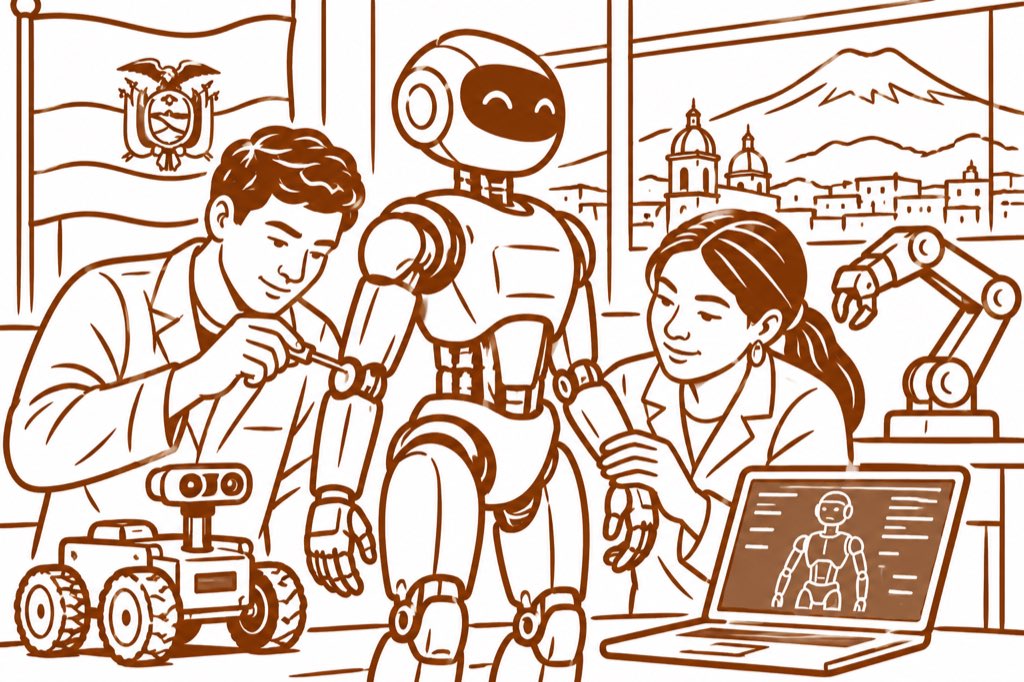
The machine, called DA²RM, is part of a growing collection of robotics projects taking shape in Ecuadorian universities. Some machines resemble people, while others travel between rows of crops, respond to electrical signals from human muscles or monitor equipment for signs of mechanical failure. Their creators are exploring a practical question: how can robotics help solve problems in Ecuador?
Teaching a robot to move
DA²RM stands 1.32 metres tall, weighs 42 kilograms and has arms, legs and sensors to help it understand its surroundings. It is a Unitree G1 EDU, manufactured in China and introduced at UPS in December 2025. The university did not build the humanoid itself. Instead, its researchers are learning to program and adapt the machine, developing movements and exploring how it can interact with objects and people.
Luis Ignacio Chávez, a mechatronics engineer involved in the project, explained to El Comercio that balance is among the greatest challenges. The surface beneath the robot's feet, the friction of its soles and the weight of whatever it carries can affect its stability. Researchers have programmed DA²RM to manipulate objects and follow routes mapped using LiDAR, a laser-based distance sensor. They are also experimenting with teaching it to imitate human movements, although that work has so far been demonstrated only in computer simulations.
For now, the humanoid operates under supervision in controlled laboratory conditions. Its immediate value is as a teaching and research platform, giving students experience with sensors, movement, programming and artificial intelligence. But elsewhere in Ecuador, researchers are building machines that look nothing like humans and may eventually prove just as useful.
At Universidad Estatal Península de Santa Elena (UPSE), students have been developing small wheeled robots designed to move through agricultural fields and identify plants. In one 2026 project, Erick Banner Cañarte Pita built a rover equipped with a camera and Raspberry Pi computer to distinguish weeds from pepper plants. Using 952 field images to train its artificial-intelligence model, the system achieved an overall identification success rate of 81.25% during testing.
The research also exposed the difficulties of taking artificial intelligence outdoors. Changing sunlight, overlapping leaves, movement and unstable wireless connections affected performance. Another UPSE researcher, Kleyner Fabricio Flores Cedeño, developed a rover that uses LiDAR to navigate between crop rows while a camera and artificial intelligence identify plants. It demonstrated autonomous navigation and real-time image processing, although some evaluation used three-dimensional plant replicas because the original specimens were no longer available.
Neither machine is a commercial agricultural product. Both demonstrate how relatively affordable electronics, sensors and software could eventually help farmers monitor crops and identify weeds. The challenge is making the technology dependable in real fields, where rain, dust, uneven ground and changing light are part of everyday conditions.
Helping people and preventing breakdowns
At Escuela Politécnica Nacional (EPN) in Quito, researchers are tackling a more personal challenge: helping people who have lost a hand recover some of its functions. The university's Alan Turing artificial intelligence and computer vision laboratory has developed a robotic hand prosthesis controlled by electrical signals from muscles in the remaining forearm.
When a person attempts to move their hand, sensors detect the muscle signals, and artificial-intelligence software interprets them before sending commands to the mechanical fingers. The system can adapt to different users, whose signals vary and may change over time. Laboratory director Marco Benalcázar told El Comercio that more than 50 people had tested the prototype, with a success rate above 85% in tasks involving opening and closing the hand.
The result is encouraging, although it measures performance on those specific tasks rather than every movement required in daily life. The technology remains experimental and has not completed the approvals needed for routine use. EPN is also applying computer vision to drones, which have been used outside the laboratory to monitor watersheds in collaboration with water-management and electricity-sector organisations. Human pilots control the aircraft while software helps interpret the images they collect.
Not every application of intelligent automation involves a machine that walks, flies or grasps objects. At Universidad UTE, researchers are using sensors and artificial intelligence to predict when industrial equipment might need maintenance. The GISER research group, led by Nelson Gutiérrez, has developed a system that monitors temperature, electrical current, speed and vibration, looking for patterns associated with mechanical wear.
Since January 2025, the system has monitored a bench drill and grinder in the university's electrical machinery laboratory. Researchers reported extending some maintenance intervals from three months to six, while bearings that previously required annual replacement had shown no critical wear after 18 months of monitoring. Longer-term data will be needed to establish how much improvement the system provides, but the potential is clear: for a factory or workshop, avoiding an unexpected breakdown may be more valuable than owning a machine that resembles a person.
From university experiments to everyday technology
Ecuadorian universities are also trying to connect researchers with businesses and one another. On November 14, Yachay Tech University in Urcuquí, Imbabura, hosted the scheduled launch of the first Ecuadorian Applied Robotics Meeting, known as EERA 2026. Organised by the university's IEEE Robotics and Automation Society student chapter, the initiative aims to encourage collaboration through technical presentations, demonstrations and competitions. Its main gathering is scheduled for December 11–13 at Yachay Tech.
Such connections could help overcome one of the biggest obstacles facing Ecuador's robotics researchers: turning promising experiments into technology that businesses and communities can use. Researchers interviewed by El Comercio identified limited funding, lengthy public procurement procedures and insufficient cooperation between universities and industry as significant challenges. Specialized sensors, industrial equipment and powerful computers are expensive, and obtaining research equipment can take months.
There is also a substantial difference between a prototype that works in a controlled demonstration and a product that performs reliably every day. A robotic hand must meet demanding safety requirements, an agricultural rover must navigate unpredictable fields, and an industrial monitoring system needs enough operating data to demonstrate dependable predictions.
Ecuadorian teams may find their greatest opportunities not in manufacturing entire humanoid robots, but in developing software, integrating imported equipment and designing specialized systems for local needs. Agriculture, aquaculture, healthcare, environmental monitoring and industrial maintenance all offer possibilities for technologies adapted to Ecuador's conditions.
Back in Cuenca, DA²RM's struggle with a cardboard box illustrates how much engineering lies behind even a simple movement. Meanwhile, researchers in Santa Elena are teaching small machines to recognize crops, and engineers in Quito are developing a prosthetic hand that responds to muscle signals. These projects remain at different experimental stages, but they are giving Ecuadorian students and researchers practical experience with technologies already changing industries elsewhere.
The country's next useful robot may not walk, talk or resemble a person. It might simply be a small machine moving slowly between rows of crops, doing one job exceptionally well.
Sources
- El Comercio — Artificial intelligence and robotics at three Ecuadorian universities, October 2, 2026
- Universidad Politécnica Salesiana — Presentation of DA²RM, December 2025
- UPSE — Erick Cañarte Pita, agricultural rover for weed detection, September 2026
- UPSE — Kleyner Flores Cedeño, autonomous crop-monitoring robot, September 2026
- IEEE — Launch of EERA 2026, November 14
- IEEE — Main EERA 2026 meeting, December 11–13