Standard
A Seat of Power: The Story Behind Manabí's Manteño Chair
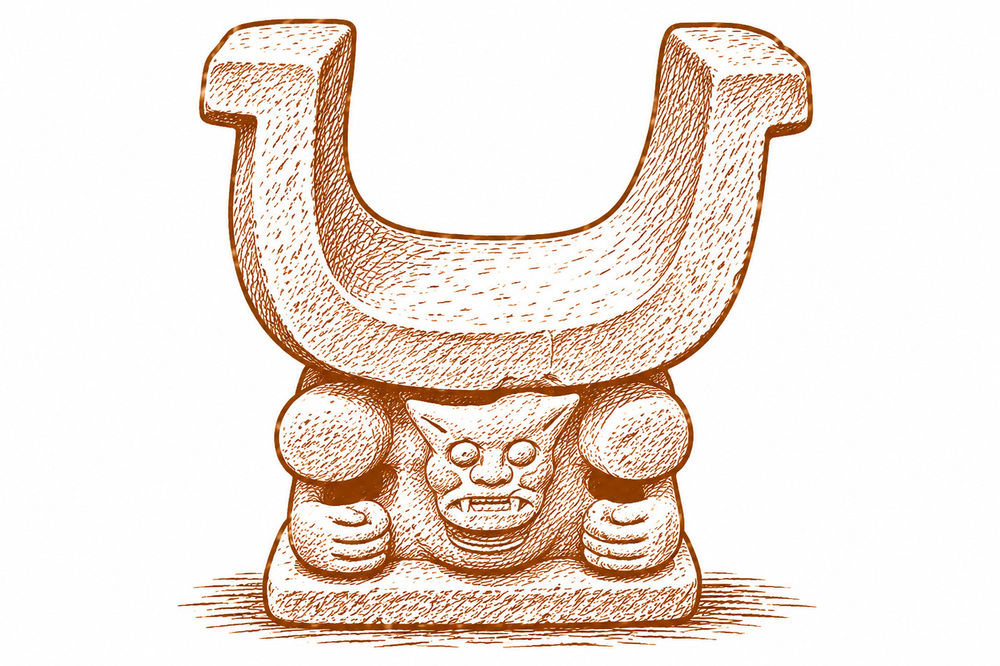
The distinctive U-shaped stone chair is one of Manabí's most recognizable cultural symbols. Its curved seat, supported by a carved human or animal figure, appears in museums and public spaces throughout Manta. Centuries before it became a symbol of regional identity, however, the chair occupied a very different place in the lives of the people who inhabited Ecuador's central coast.
From approximately 800 AD until the arrival of Europeans in the 16th century, the Manteño people built settlements in the coastal hills, cultivated the surrounding land and established maritime trading networks along the Pacific. Their stone chairs offer a glimpse into how these communities were governed.
More than a place to sit
Carved from single blocks of stone, the chairs vary considerably in design. Some rest on crouching human figures, others on animals resembling jaguars. The choice of figures and the care taken in carving them suggest that their purpose extended beyond providing somewhere to sit.
Archaeologists have discovered chairs arranged in circles and along the sides of ancient buildings. Rather than a single ruler seated above everyone else, these arrangements suggest gatherings of people who shared positions of authority.
In an essay published by the Metropolitan Museum of Art, Ecuadorian archaeologist Florencio Delgado Espinoza examines the relationship between these objects and political power. The seats may have been occupied by community leaders during gatherings where decisions were made, disputes resolved and religious ceremonies performed.
Lords of land and sea
In the hills between Manta, Montecristi and Portoviejo lies the archaeological complex of Cerros Hojas-Jaboncillo. Stone foundations, agricultural terraces and ceremonial platforms reveal the remains of extensive settlements where the Manteño people organized community life and cultivated the surrounding slopes.
Their world extended far beyond these hills. Using large sailing rafts, coastal traders transported goods along the Pacific. Among the most prized was the Spondylus shell, whose brilliant red and orange colours held religious and ceremonial significance for societies across the ancient Americas.
These maritime connections brought coastal Ecuador into contact with distant communities. Farmers, fishermen, merchants and specialized artisans formed part of a society whose wealth depended on both the land and the sea.
The stone chairs, found within its ceremonial and political spaces, provide a tangible connection to the people who exercised authority in this society.
Rediscovering the Manteño
In 1906, American archaeologist Marshall H. Saville began investigating archaeological sites in Manabí. His discoveries attracted international attention, and stone chairs recovered during early expeditions eventually found their way into museum collections overseas.
More than a century later, residents of Manta are helping those museums interpret the objects. During 2024 and 2025, representatives of Manta's Civic Committee for Historical Memory visited the American Museum of Natural History in New York, bringing local knowledge and cultural perspectives to the interpretation of a Manteño chair in the museum's collection.
Back in Manabí, modern technology is revealing structures that earlier archaeologists could not see. Researchers from Ecuador's National Institute of Cultural Heritage have used LiDAR laser scanning to identify archaeological features concealed beneath vegetation. Subsequent fieldwork led to the recovery of fragments of another stone chair from a pre-Hispanic platform.
A heritage that lives on
At Ligüiqui, south of Manta, stone fishing enclosures become visible as the tide recedes. Local fishermen continue to use these structures to trap fish, drawing on generations of knowledge about the ocean and its rhythms.
In 2026, Ecuador added Manteño Culture: Lordships of Land and Sea to its UNESCO World Heritage Tentative List. The proposal brings together archaeological settlements, traditional fishing practices and craftsmanship, connecting the achievements of an ancient coastal civilization with the cultural heritage of present-day communities.
The next time you encounter a Manteño stone chair in Manabí, look closely at the figure supporting its curved seat. Centuries ago, an artisan carved that figure for someone who occupied a position of importance within their community. Today, the chair itself occupies a place of honour in the region's cultural identity.