Standard
From the Food of the Gods to the Golden Seed
Ecuador's 5,300-year journey with cacaoBreak open a ripe cacao pod and the contents bear little resemblance to chocolate. Inside the thick, colourful shell, rows of seeds are surrounded by soft, white pulp with a sweet, slightly acidic flavour. For the ancient inhabitants of Ecuador's tropical forests, the fruit offered possibilities beyond the bitter seeds from which chocolate is made today.
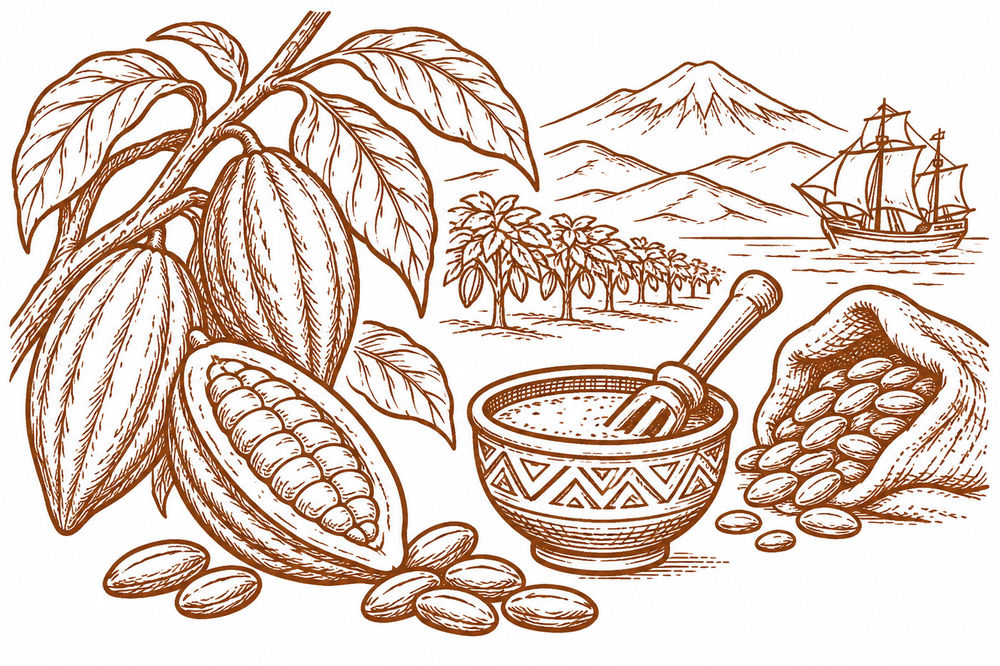
Over thousands of years, cacao would become a ceremonial drink, a form of currency, a European luxury and an industrial food. It would build fortunes, transform cities and help shape the economy of an independent Ecuador. Its earliest documented chapter begins in a forested valley in the south of the country.
Before there was chocolate
Near Palanda, in Zamora Chinchipe province, the Andean mountains descend towards the Amazon basin. In 2002, a Franco-Ecuadorian archaeological team led by Francisco Valdez discovered the remains of Santa Ana–La Florida, a settlement belonging to the ancient Mayo-Chinchipe civilization.
Among its ceremonial structures and burial sites were finely crafted ceramic bottles and bowls. Although their contents had disappeared thousands of years earlier, microscopic traces remained within the pottery.
In October 2018, an international team published its findings in Nature Ecology & Evolution. Cacao starch grains, traces of a naturally occurring chemical called theobromine and fragments of ancient DNA provided three independent lines of evidence that cacao was being used approximately 5,300 years ago.
The discovery placed the upper Amazon at the centre of cacao's early domestication history, challenging the long-held association of its origins with Mexico and Central America.
Exactly how the inhabitants of Palanda consumed cacao remains uncertain. The sweet pulp could be eaten fresh or fermented into an alcoholic beverage. A 2007 archaeological study in Honduras suggested that fermented drinks made from cacao pulp may have preceded beverages prepared from ground seeds.
Chocolate may have emerged from a much older tradition of making drinks from tropical fruit.
A commodity before Columbus
Long before Europeans crossed the Atlantic, cacao was travelling across the Americas. Seeds exchanged between communities were planted in new environments, where generations of cultivation produced varieties with different characteristics.
A 2024 study of residues from 352 archaeological objects, associated with 19 ancient cultures, revealed extensive movement and mixing of cacao populations across South and Central America.
Cacao also reached the Ecuadorian highlands. Research published in 2025 identified cacao starch grains in a pre-Hispanic ceramic vessel from Chillogallo, in present-day Quito. Communities living far above the tropical forests had access to cacao and may have consumed it as a beverage.
In Mesoamerica, cacao developed into a sophisticated culinary tradition. Fermented and roasted beans were ground and mixed with water, sometimes flavoured with maize, chilli or vanilla. Pouring the liquid between vessels produced a prized layer of froth.
Among the Maya and Aztecs, cacao was associated with hospitality, marriage, religious ceremonies and political authority. Its beans also served as currency.
Columbus and the mysterious beans
During his fourth voyage to the Americas in 1502, Christopher Columbus encountered a large Indigenous trading canoe near Guanaja, off the coast of present-day Honduras.
His son Ferdinand recorded a curious incident. Among the canoe's cargo were objects resembling almonds. When some fell to the floor, the traders hurried to recover them, treating each one as something precious.
They were cacao beans.
The Europeans had encountered a commodity with an established commercial value and a culinary history stretching back thousands of years, yet they barely understood its significance.
From a bitter drink to a European luxury
During the 16th century, chocolate gradually entered Spanish society. European consumers adapted Indigenous recipes, adding sugar, cinnamon and other ingredients. By the 17th and 18th centuries, drinking chocolate had become fashionable among wealthy Europeans, with specially designed pots and cups appearing in aristocratic households.
Growing demand encouraged the expansion of cacao and sugar plantations across the Americas, many dependent on enslaved labour.
For centuries, however, chocolate remained primarily a beverage. Industrialization changed that. In 1828, the Van Houten cocoa press made it possible to separate cocoa butter from ground cacao. In 1847, England's Fry & Sons introduced a commercially produced solid chocolate. Milk chocolate followed in the 1870s, and new processing techniques created smoother textures.
These innovations in chocolate manufacturing transformed an expensive luxury into an increasingly affordable food, opening an enormous international market for cacao.
The rivers that carried Ecuador's wealth
The origins of Ecuador's celebrated Nacional cacao can be traced to the southern Amazon. A genetic study published in 2012 identified wild populations in this region as ancestors of the aromatic variety that would establish Ecuador's international reputation.
During the colonial period, cultivation expanded along the Guayas River and its tributaries. These waterways carried sacks of dried beans from inland plantations to the port of Guayaquil. The designation Arriba, still associated with Ecuador's fine-flavour cacao, reflected its origins upriver.
Guayaquil's merchants supplied not only Europe but also Mexico, where chocolate consumption remained rooted in local culture. By the late 18th century, shipments of Ecuadorian cacao through Acapulco were helping meet Mexican demand and keep cacao prices affordable.
Thousands of years after cacao had spread northwards through the Americas, the same regions were once again connected through trade.
By the late 19th century, Ecuador had become the world's leading cacao exporter. Wealthy plantation-owning families, known as the Gran Cacao, invested their fortunes in banking, commerce and property, helping transform Guayaquil into a major trading city.
The prosperity extended inland. In Los Ríos province, towns such as Vinces acquired elegant buildings influenced by European architecture, while cacao revenues supported the development of public services, including telegraph networks, libraries, markets and docks.
Behind these fortunes were generations of rural workers who planted the trees, harvested the pods, fermented the beans and dried them under the tropical sun. As Ecuador's Central Bank Museum documents, the prosperity of the cacao industry was accompanied by concentrated land ownership.
Cacao had become Ecuador's pepa de oro — the golden seed.
When the golden age ended
During the early decades of the 20th century, two fungal diseases devastated Ecuador's plantations. Moniliasis, or frosty pod rot, attacked the fruit, while witches' broom damaged growing shoots and flowers.
Disruptions to international trade, falling prices and growing competition from African cacao producers compounded the crisis.
The consequences extended far beyond the plantations. A scientific review of cacao diseases in the Americas connects the collapse of Ecuador's cacao industry with the economic crisis and social unrest that culminated in Guayaquil's tragic events of November 1922.
An agricultural disease had helped undermine an entire national economy.
Cacao cultivation survived, but the era of the Gran Cacao was coming to an end.
Rediscovering an ancient heritage
More than two decades after the archaeological discovery at Palanda, Ecuadorian scientists continue to uncover new chapters in cacao's history.
On November 26, the National Institute of Cultural Heritage and Quito's Casa del Alabado Museum opened Tiempo de Cacao, an exhibition bringing together archaeological vessels, historical photographs and recent laboratory discoveries. It runs until January 28, 2027.
Ecuador has also placed its Cacao Cultural Landscape on UNESCO's World Heritage Tentative List, recognizing the landscapes, communities and traditions associated with centuries of cultivation.
From the ancient ceramic vessels of Palanda to the plantations of Los Ríos, cacao has shaped Ecuador's history in ways that extend far beyond agriculture.
The next time you break a piece of Ecuadorian chocolate, remember that its story began long before European chocolate makers, colonial merchants or even Columbus. More than 5,000 years ago, people living in the forested valleys of southern Ecuador had already discovered the possibilities hidden inside that colourful tropical fruit.