Featured
Ecuador's Gold: Who Gets the Wealth, and Who Pays the Price?
From Canadian-operated mines in the Amazon to protests over Cuenca's drinking water, Ecuador's gold industry promises investment, jobs and export earnings. But it also raises questions about environmental protection, foreign ownership and the growing involvement of organized crime.
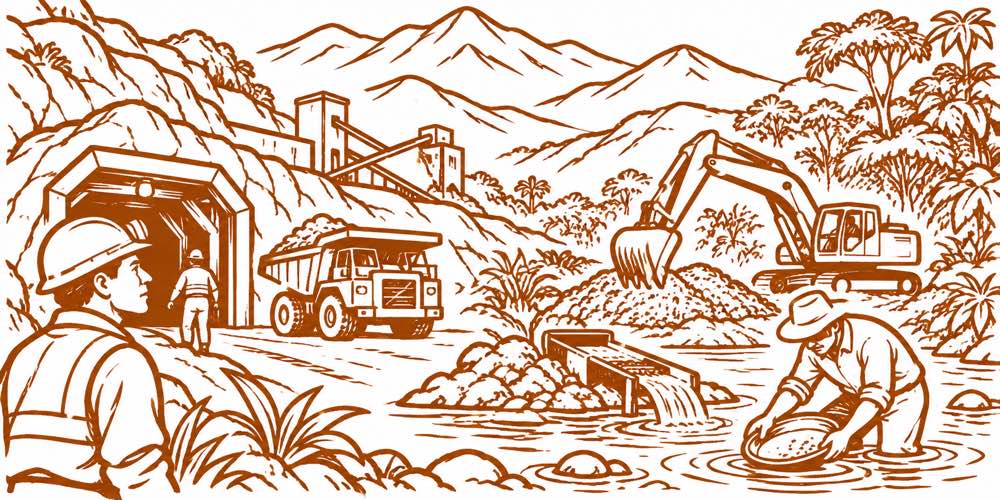
A New Gold Rush
In September 2025, tens of thousands of people marched through Cuenca to oppose a proposed gold mine near the city's water sources. Three weeks later, Ecuador revoked the project's environmental licence. Yet elsewhere in the country, gold mining was booming.
Gold mining is nothing new in Ecuador. The southern towns of Zaruma and Portovelo have depended on it for generations, and small-scale mining continues to support families and businesses. What has changed is the scale of modern extraction and the growing international interest in Ecuador's mineral deposits.
In Zamora Chinchipe, Canadian-owned Lundin Gold operates Fruta del Norte, one of the country's largest gold mines. In 2025, it produced 498,315 troy ounces—approximately 15.5 tonnes—of gold. The company reported annual revenue of around $1.78 billion. Source: Lundin Gold.
Gold is usually embedded in rock rather than found in nuggets. At Fruta del Norte, miners drill and blast underground, bring the ore to the surface, crush it and process it to recover the metal. The mine handled approximately 1.83 million tonnes of ore in 2025.
Other deposits are worked through open-pit mining, which removes rock from the surface in enormous excavations. Both methods require machinery, waste management and water controls. Underground mines have smaller surface excavations, but neither method is free of environmental risks.
The Other Gold Rush: Livelihoods and Criminal Profits
In the gold-producing districts of Zaruma, Portovelo and Camilo Ponce Enríquez, mining is not simply a business for multinational corporations. Small operators and family enterprises extract gold from underground veins, sometimes using relatively modest equipment and selling their ore to processing plants. The industry supports miners, truck drivers, mechanics and local businesses.
Ecuador recognizes both artisanal mining and small-scale mining as legal activities when properly authorized. Artisanal miners can work individually, as families or in associations under a permit system. Small-scale mining operates under a separate regime that allows larger production volumes. Both are subject to environmental requirements and official controls.
Alongside these legitimate operations, unauthorized mining has expanded into remote forests and river valleys. Some miners work without permits or outside approved areas, while criminal organizations have increasingly entered the industry, controlling territory, demanding payments and profiting from extraction and trade. Small-scale mining is not synonymous with illegal mining, and not every unauthorized operation is controlled by a criminal gang.
Unlike cocaine, gold is a legitimate international commodity. Once illegally extracted gold passes through buyers and processing facilities, its origins can be difficult to establish. Investigations by the Global Initiative Against Transnational Organized Crime have documented how criminal networks exploit weaknesses in Ecuador's mining and commercial oversight.
The environmental consequences are visible from space. Satellite monitoring in Napo has documented mining-related deforestation and disturbed river systems. Excavation removes vegetation, alters waterways and leaves sediment and processing waste that can affect surrounding ecosystems.
Gold Inside a National Park
In March 2026, Ecuadorian authorities launched a major operation inside Podocarpus National Park, which extends across Loja and Zamora Chinchipe.
They reported destroying 94 illegal mine entrances, 129 camps and 56 crushing machines. The operation exposed an extensive network of underground workings and processing facilities inside an area where mining is prohibited. Source: Ministry of Environment and Energy.
Satellite researchers had already documented mining damage along the Loyola River inside the park, including changes to the river's course.
The situation illustrates the growing overlap between Ecuador's environmental and security problems. Illegal mining can damage forests and waterways while providing income to criminal networks. Removing machinery and closing tunnels addresses immediate operations, but lasting control also requires action against those financing and purchasing illegally extracted gold.
Foreign Money, Ecuadorian Resources
Canadian companies have become prominent in Ecuador's gold sector, while Chinese investors have made major commitments to mining, particularly copper. The Chinese-controlled Mirador project, also in Zamora Chinchipe, is primarily an open-pit copper mine, while Chinese-backed Río Blanco in Azuay became embroiled in legal disputes over consultation with local communities.
Ecuador is part of a much larger South American mining industry. Peru is a major producer of both gold and copper, while Colombia has long struggled with illegal gold extraction and its links to armed groups. Ecuador's industrial sector is comparatively young, and the country faces conflicts over environmental protection and illegal extraction already familiar elsewhere in the region.
Foreign investment brings capital, technology, employment and export earnings. Mining companies pay taxes and royalties, purchase goods and services, and employ Ecuadorian workers. The unresolved issue is how those benefits are distributed, particularly among communities closest to the mines.
Cuenca's Battle Over Water
The Loma Larga project illustrates why legal mining can be controversial. Canadian company DPM Metals proposed a $419 million underground gold mine near Quimsacocha, a high-altitude wetland ecosystem that helps supply water to Cuenca. The company maintained that the mine could operate safely, but opponents feared contamination and disruption of drinking water and irrigation supplies.
Following the September 2025 protests, Ecuador revoked the project's environmental licence in October, citing technical concerns raised by local authorities. The dispute brought into focus a question facing mining communities across Ecuador: how much economic benefit justifies the potential risk to an essential water supply?
Who Benefits—and Who Pays?
For Ecuador, the benefits of gold are substantial: export earnings, employment, investment and government revenue. Mining supports livelihoods from industrial workers in Zamora Chinchipe to small operators in El Oro.
But the costs can fall on different people. Communities near industrial projects may face concerns over water and land use. Residents near illegal operations can experience damaged rivers, deforestation and criminal intimidation. And when gold enters international markets through poorly documented supply chains, the profits may travel far beyond the communities where it was extracted.
The experience of Cuenca, the production at Fruta del Norte and the illegal mines inside Podocarpus reveal three sides of the same industry: valuable resources, competing interests and difficult choices about environmental protection.
Ecuador has gold beneath its mountains and forests. The question is how much of that wealth will benefit the country—and what Ecuador will lose in extracting it.